Mostrando postagens com marcador race. Mostrar todas as postagens

sábado, 17 de novembro de 2018

Umoks

Creatures slither across the humid jungle while powerful jaws drip. A bamboo grove blocks the way: the creatures bite and tear apart trunks as if they were just sticks. Soon those mouths would split open the enemy's armor in the same way.
Mauleosteus, nicknamed "Maul". Exiled from his tribe, he chose the Northern Empire as his new one. His efforts in exploring the umok archipelago for the northern civilization granted him an imperial citizenship, the title of "dom" and his very own caravel. Maul is unique among his race for having some reptilian traits such as the type of scales. After speaking with a shaman, he says that he reincarnated with traits of his former life. Despite his appearance, he is quite friendly towards new people.

The umoks waited in the water. Being hooked by them was the end: no one returned from the dark and increasingly red waters. And despite the screams of pain, the rattling of swords and the rhythm of the waves, there wasn't a stronger sound than the bellowing of the gongs the umok war bards fastened to their arms like shields. That terrible rhythm was only broken when the gongs were actually used for defense, against brave northerners which learned the strength of the arms and clubs which hit the gongs. The songs in rough voices coming from bloody jaws foresaw the defeat that the empire would suffer that day.
-Lucan de Camina, author of Norteia, epic about the first northern expedition to the umok's home archipelago and the Battle of the Sharks.


Legends and Oral Traditions

https://upload.wikimedia.org/wikipedia/commons/thumb/a/ae/Nagas_Royal_Carriage.JPG/320px-Nagas_Royal_Carriage.JPGThe umoks believe that their chaotic character and physical traits come from their origin. Each tribe seems to have a different version, but the myth goes more or less like this: a group of dragons similar to sea serpents, the kupuas, were jealous of their draconic cousins of Drakhazin, for they had the obedience, fear, loyalty and even love of races like the zitai. Mo-o Inanea announced he knew Kane, a secret island where the clay was so full of life, it could be used to create their own race. The kupuas hurried in using it to sculpt the umoks. They started with a version based on a certain animal, but soon grew bored and tried other versions using new creatures:fishes, reptiles, amphibians and even mammals were copied. This cycle repeated many times until Kiha-wahine suggested that they picked up a trait of each version: After discussions and fights, they decided for the variations that the race has up to this day: a member of the race can be born with one of many types of heads, like eels, sharks, placodermi, piranhas and every type of carnivorous fish. The umoks believe that this chaotic process made them naturally adverse to boredom when compared with the other races. This trait also prevented them from completely serving the kupuas, although umoks regard the latter as sacred ancestors to which they offer tributes and sacrifices. These entities are said to live to this day in secret islands, tribal sanctuaries that only the shamans know.


Anarchic Heritage


The umoks are beings of rough constitution; bestial and hybrid appearance; savage, dynamic, chaotic and, often, inconsequential behavior. Natural amphibians, umoks make good pirates and quickly adapt to the intricate reefs and sea currents where their tribes raise their homes. They are creatures that feel compelled to let go of routines and hardly remain in a single place for long. Most umoks live in nomadic tribes dedicated to hunting, fishing, gathering and plundering, or offer their skills to people which might pay more or offer good life conditions. One in each ten umoks is an adventurer, explorer, merchant or hunter of sea beasts. While adventurers are marginalized in the imperial society, among umoks they are the center of attention. The objective is to gather fame, fortune and followers to create your own tribe and be immortalized in the latter's legends. A common way to do so is accumulate treasures in the tribal refuges where the ancestors' remains are laid down and/or lives one of the dragons which created the race. One never knows when a kupua might return and be impressed with the adventurer's dedication. The rewards vary: secret information; powerful blessings; the location of sunk treasure; or even the privilege of escorting the dragon on his next swim.

https://upload.wikimedia.org/wikipedia/commons/thumb/b/bb/Sail_plan_tepukei.svg/231px-Sail_plan_tepukei.svg.png Great navigators, umoks value the building of vessels. The master artisans have each their own techniques, but they also incorporate foreign elements or renovate salvaged ships. The exclusively umok traits of a ship are: using bamboos of the umok archipelago; and mouth-like sails. Speed and agility are deemed more important than resistance or the volume of carriable cargo, resulting in many thin-hulled catamarans.


Places

  • Hundreds of umok tribes live in Umokaong, an archipelago so vast and labyrinthine that no one has managed to completely map them. At some places the ocean seems more like many salty rivers divided by reefs, sand banks and islets. The Northern Empire currently dominates Ibalong, a triangle-shaped great island, with a volcano in each corner: Hantik, Kolasi and Isarong. The geography is diverse: plains suitable for water buffaloes with huge curved horns, plantations of the valuable sugar cane, umok coastal villages, floating markets and hundreds of canoes; entire lakes dedicated to raise armored catfishes which eat wood and cane berry, named "cascudos"; mangroves where everything tastes like salt; northerner communities with colonists of many races; bays which can house a whole fleet; two mountain chains with icy peaks and active volcanoes; jungles with not even the umoks fully explored.  
  • Tavira Shore - This city is the greatest concentration of umoks in the whole empire; many of which were born here. The population is spread out along a rocky peninsula shaped like a horseshoe. Many sea currents meet nearby and islets appear at the low tides. Dozens of ships run aground along the years were turned upside down and raised over stilts to serve as houses. Fishing and aquaculture sustain over twenty thousand inhabitants. The community exists due to four treasures that only umoks can fully explore: pearl farms among the rocks, using secret techniques to produce pearls in many sizes, shapes and colors, including variations specific to sacrifice to Nyxcilla; whaling expeditions bring much meat, oil, ketin and bones to the city, at least the ones which return; seaweed orchards have many alchemical uses; the amphibian race also put many nets in certain places to catch drifting items, be them wood, wounded whales, empty boats, leather shoes, lobster or chests fallen off ships. The wealth accumulated by the local leader and merchant, Perolos de Ergas, was enough for him to buy the title of viscount and transform a galleon into a floating fortress. He also has the attention of rich and politically relevant clients. This exotic noble raised an amphibian militia which uses halberds and brass cuirasses decorated with black and red pearls. They have a lot of experience in fighting pirates, smugglers and giant crabs amidst the semi submersed caves, mangroves and a graveyard with anchor-shaped tombstones which contains as much ships as peoples.

Umok Traits


  • Speed. Your base walking speed is 25 feet and your base swimming speed is 30 feet.
  • Amphibious. Umoks can breathe underwater as well as out of it.
  • Weapon Proficiency. You are proficient with acangapemas, nets and spears.
  • Skill Proficiency. You are proficient in survival.
  • Chaos Jaws. All umoks have powerful jaws which he can use to attack as a natural weapon which causes 1d8 points of piercing damage and uses strength for attack and damage.
  • Each umok's mouth also gives him unique powers. Choose a characteristic among the ones below. Optionally, if the Master allows, you can choose one of the options at random. If you do so, you add to the result under parenthesis to your character's traits.
    • 1. Big Teeth - Your bite attack deals 1d10 points of piercing damage (Sharp teeth - you can cause critical hits with your bite attack in a result of 19 or 20 in the d20).
    • 2. Long Tongue - You gain an attack with your tongue. It is a natural weapon which deals 1d6 points of bludgeoning damage up to 20 feet away and has the Finesse propriety (Sticky Tongue - If the target is up to a size category bigger than you it is grappled. If you attack another target, the first one is freed).
    • 3. Toxic Saliva - Choose if your bite attack causes poison or necrotic damage. The final choice remains the same for the rest of your life. (Virulent Saliva - the damage of your bite attack is dealt directly into the target's maximum life and persists until the latter has a long rest).
    • 4. Mystic Voice - You can create an effect of ventriloquism, making so that the sound of your voice comes from somewhere else up to 60 feet away (Supernatural Voice - You can reproduce any sounds you have heard, including voices. A creature that hears you can say if they are imitations succeeding on a Wisdom [Insight] ability check. The DC is equal to 8 + proficiency + your Charisma modifier).
    • Ability Score Increase. Your Constitution score increases by 2 and your Strength score increases by 1.
    • 5. Hungry Throat - You can consume foodstuffs equal to, in terms of quantity, one day's worth of rations, in a single action. Every time you do so, you can immediately use one of your HP dice to heal the same amount of hit points equal to the dice's result + Constitution modifier (Abyssal Throat - If you hit a bite attack against a creature at least one size category smaller than yours, you can swallow the target. The swallowed creature becomes restrained and blind, has full cover against external attacks and other effects, and suffers 3 [1d6] points of acid damage in the beginning of each of your turns. You can only swallow one creature. If you are reduced to 0 hit points, the creature isn't restrained anymore and can escape by using 5 feet of its base speed, leaving prone).
    • 6. Roaring Voice - You can vocalize an extremely loud scream in a 15-feet cone. Creatures in its area must pass a Constitution check. All creatures which fail it must become stunned until the beginning of your next turn. You must have a long rest before using this skill again (Thundering Voice - creatures suffer 2d6 points of thunder damage, or half if they are successful at their Con check. This damage increases to 3d6 at the 6º level, 4d6 at the 11º level and 5d6 at the 16 level).

quinta-feira, 20 de setembro de 2018

Shardokan, dwarf ethnicity

Some dwarfs descend from an old foreign lineage mixed with mountain tribes, exchanging the underground regions for the high and cold mountains. An ethnicity only three hundred years old, the shardokan are dwarfs yearning to overcome difficulties and always willing to face a good challenge.


The falling snow warms my heart, and glorifies the desolation in these rugged mountains, Sharp cold and mindless beasts. It galls me to hear that dwarfs can’t enjoy beauty. Everybody else runs after the elves, forgetting about all the other ways the world can be beautiful. The white brightness of snow, drops of hot fat from roasted ribs, the hidden tenderness in a dwarfwoman’s hips, all unbeatable beauties.

-Nartazov Yaroslav “Kochul” Streltzy, the great kurskian pioneer which delved into the Hamask Barbagia Range. First of the shardokan, meaning “folk of the keen shards”, leader of the Nartazov clan. Missing.


Brave and Passionate

Shardokan are seen by the thorakitai dwarfs as rustic and even primitives. The shardokan themselves are proud of what they see as a greater "inclination to independence" that their cousins don't have. This is also reflected in the clan's loyalty. While the thorakitai are very communal, shardokan might have individual iniciatives in which sucess has more worth than honour, specially when it comes to protecting family, friends and one's home. At war, shardokan are more aggressive, wielding bardiches instead of spears, defending themselves with grenades instead of shields. Outside combat, they're more reserved regarding strangers. Dry and taciturn in public, Hearty and laughing in private. The shardokan themselves say: "as the heart only beats inside one's chest, the noises of friendship and love beat inside one's home."

Faraway and Icy Origin

Shardokans know how to work with materials uncommon among the most renowned crafters of Ghara: ice and pykrete. As they live in high, cold lands where the ice doesn't melts, they use it for building, creating semi underground halls, cities inside glaciers and even pykrete towers that can resist cannon balls. The shardokan themselves say this born talent comes from their old ancestor lineage: all shardokan descend from the union of old mountain dwarf barbarians and the nomad kurskian clan lead by Nartazov Yaroslav.

Practicality Allied to Difficulties

Above all, the shardokan value the challenges brought by the day-to-day in their habitat. For these dwarfs, difficulties are blessings brought by the gods, specially Corallin, as an opportunity to evolve their own competences, a way of thinking which is correct, up to a point. Shardokan believe that the most apt will be the ones that will carry on one's legacy. Therefore, despite their appreciation in going through difficulties as a way to be tested, it doesn't means that they will purposefully try to solve troubles in the hardest way. A shardokan will not hesitate to use several ways to pass over an obstacle, a healthy mix of stubbornness and resolve. The best way to "kill" a shardokan, as they say themselves, is to give them a comfortable life, calm and far from troubles and precious obstacles that could be used as a way to improve all the aspects of one's life. Due to these traits, these dwarfs like something brought by Yaroslav in the form of an arquebus: gunpowder. More than their cousins, the shardokan like the smell of the "noisy solution" that they say the substance has, and firearm users are common in their clan's garrisons.
 
Unique Beliefs
 
Shardokan believe in a second soul that exists apart from the "primary soul" that other cultures believe in, the "name-soul". This is the basis for the importance of the clan: they're all those which share the same surname, and, therefore, the same soul that said surname defines. The name-soul never reincarnates, but stays in the world as long as at least one person is thus named. The name-soul has a power of its own, making that its hosts (and their primary souls) acquire traits of it. That would be the reason that the members of the Kalinin clan insist on haggling under any and all circumstances, or why all the Garka are allergic to pine trees. The "half-dwarfs" in the shardokan epic, The Three Journeys of the Clan, were said to be members of other races that, upon becoming part of the Vainala clan, gained the latter's traits and thus, survived the cold as the non-dwarfs died. Humans in body, but half-dwarfs in soul. And it seems to be a mutual process, for the Vainala are slightly taller than the dwarfs of other clans.

Important Places
  • The Sclaveni Cryopolis is the greatest city in the mountain range, as well as the largest concentration of shardokan in the empire. It is in the Spotted Mountains, thus named due to the contrast between the snow and the plantations of dark cactuses and black lichens. The alpine climate along the year makes ice and pykrete building materials as common as stone, while wood is a luxury for few. The locals think of 0 ºC as mild, and the record of 20 ºC thirty years ago still feeds conversations. The most noteworthy thing in the landscape is a huge glacier, almost broken in two, on the slope of the mountain which shadows the city. Here the locals mine granite, sulfur, coal, ice and the unique material found here, eternal ice, which never melts. This fantastic substance allows the creation of freezers for foodstuffs, production of ice and even ice cream throughout the empire, cooling for the places of nobles and soldiers inside heavy armor. 
  • Buttress of Thorns. A small town with  a few hundred shardokan and a minority of other people, it is located at the south most extreme of the Hamask mountain range. Inside its great walls, almost a kilometer long, live the families of several dozen warriors. These man and women have lived here for years, protecting southern Kavaja from the threats of the Unquiet Lands, a place infested by nefilims. The attacks are rare, but when they happen, the shardokan lead their battle-ready forces towards the fight.
  • Kurskgrad City-States. Few things are more amazing than the tunnel networks and the cities of Kurskgrad, the gigantic dwarf underground civilization in the Drakhazin continent. Each community is built inside a giant geode, grown as if it was a plant by the kurskian geomancers. They also shape the buildings of fluorescent crystal inside, out of stalactites and stalagmites. It is said that Kurskgrad housed the first dwarfs to step in the surface. The truth of it is unknown, but most dwarfs agree and are devoted to spread the fame of the cities throughout the world when they become a topic.
  •  
Shardokan Traits
  • Mountain Born: you're acclimated to high altitude and cold climates.
  • Frozen Crafts: the benefits of "stonecunning" also apply to objects and buildings made out of ice, pykrete and eternal ice.
  • Mountaineer Build: your Strength score increases by one.
  • Weapons Training: you are considered proficient in the use of the bardiche.
  • Comrade: as an bonus action, you may move up to your speed toward an allied creature that you can see and has an enemy creature adjacent to it.

domingo, 16 de setembro de 2018

Goblinoids - Goblins and Hobgoblins

Enslaved and oppressed by fallen empires. Classic and eternal enemies of adventurers and civilization in the present. The goblinoids went through a great change after the end of the Retaliations War, changing the perspective of their future.

Makhila Segovax by AlexandreLeoniART
You are a mighty beast, but these people won't be your prey. Barkatu, agur.
-Makhila Segovax, hobgoblin hunter renowned in the empire, among goblinoid tribes, and beyond.

Challenges of the Past


     Hobgoblins and goblins appeared almost at the same time, due to the actions of the great Idura. The first became a physical race after Idura conquered a fairy forest, a feast which awakened a rage into the Royal Ents. The revenge was terrible for some: for many years, children throughout the world were born with traits similar to the newly appeared hobgoblins. The goblins descend from these fusions of mortal and fey.

     The loathing of "civilized" people only increased when the goblinoids were enslaved in great numbers by the Amaranthine Empire. Centuries of oppression fed rebellions helped by an invention originated from the many herds they were forced to take care of: the composite bow, a mixture of wood, horn and sinew which could pierce the armour of their masters. The Northern Empire, which sees itself as successor of the amaranthines, still blames the goblinoids for the destruction of their ancestors. The truth is more complicated, for the old empire had more troubles than the goblinoids rebellions. Guided by the wisest goblinoid ethnicity, the maubor, goblins and hobgoblins carved the former imperial lands into the domains of countless tribes. Centuries of tribal conflict happened since then. The Northern Empire acquired millions of goblinoid slaves, many sold by other goblinoids.

     In 1390 Post-Idura, a foreigner calling himself Lord Pain united them under a single banner, defeating tribes and assimilating them under a mix of army and migration. More than two hundred thousand warriors and their families invaded several regions of the Northern Empire, by land and sea. The following Retaliations War lasted from 1399 to 1402. The name comes from the fact that both sides saw it as an answer: goblinoids wanted to punish those arrogant imperials which repeated the mistakes of their predecessors, imposing an order and civilization which saw the "barbarian people" as inferiors; the Northern Empire considered the war as a revenge against those which had destroyed the glorious Amaranthine Empire. Against all expectations, the war ended on a peace treaty in which most of the slaves throughout the empire were freed. Since then, most of the goblinoids went back to the southern lands, forming cities and tribal confederations, for they learned how strength comes from union. Many settled in areas of the empire while others, mostly former slaves, became imperial citizens. The consequences of such changes still occur in the Goblinoid Lands and the northern fiefs.

Heroes of the Present


     Nowadays, with the migration of huge numbers of goblinoids into the imperial social classes, their presence is as common as many other races in the urban scenery.

     Goblins find it every easy to join the urban labyrinth of the big cities, and one can find them in the rumble of the markets as well as the dark alleys. Some even show talent beyond expectations and conquer greater status, as business owners and even nobles (although, in human cities, goblin nobles are still rare). Most are obsessed with collecting some kind of item: spoons, parts of defeated enemies, pretty rocks etc. Some prefer more abstract things, like stories and friendships. The sought after item usually determines the goblin's profession and attitude. A rogue may simply seek opportunities to gather padlocks, a shoemaker wants to use every possible type of leather for his shoes.

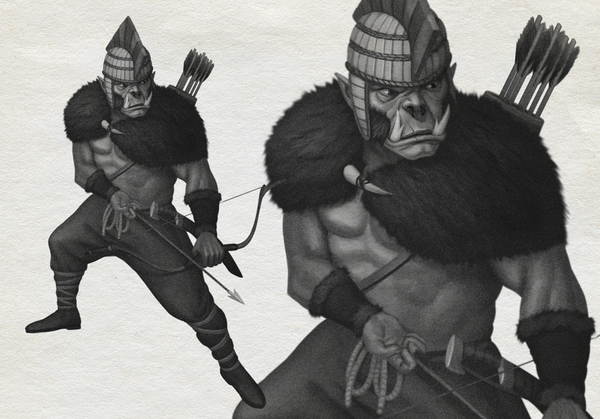
     Hobgoblins don't appreciate the confusion of cities. They seem satisfied with occupying the woods and jungles, devoted to nature, spiritism and ritualism. The oppression that the so called "civilized" people caused them still weighs on their racial soul. But they still found their place as hunters, shepherds, veterinarians and archers, specially in the imperial army. The huge majority of them believes that every individual has a spiritual brother, usually an animal which was born close to the hobgoblin tribe and roughly at the same time. The "animal-brother" is seen as a family member and a guardian: someone which is always watching and reminding one to walk the right path with this new chance.

     Due to all this, of course, the goblinoids wouldn't be different from the other races with which they share ground on Ghara and adventurers aren't unusual. Adventuring parties with goblinoid members, or even entirely formed by goblinoids, have become a more frequent sight. Some even got a certain renown similar to local heroes. It is becoming ever more likely that there are legendary members, like those of other races, decorating the statue rows in the cities.

Goblinoid Traits


     The goblinoids share the following traits:
  • Ability Score Increase. Your Dexterity score increases by 2.
  • Darkvision. Accustomed to twilit forests and the night sky, you have superior vision in dark and dim conditions. You can see in dim light within 60 feet of you as if it were bright light, and in darkness as if it were dim light. You can't discern color in darkness, only shades of gray.
  • Stealth Proficiency. All goblinoids are proficient on the Stealth skill.
  • Languages. Goblinoids speak, read and write in Common* and Goblinoid**, using the common alphabet. The goblinoid language has many sharp consonants which often express more through their sounds than their literal meaning.
  • Ethnicities. Next is a brief description of the two most common ethnicities in Ghara: goblins and hobgoblins.

https://img00.deviantart.net/66f9/i/2015/162/6/5/taliok_dark_veil_by_alexandreleoniart-d8wvkh1.png
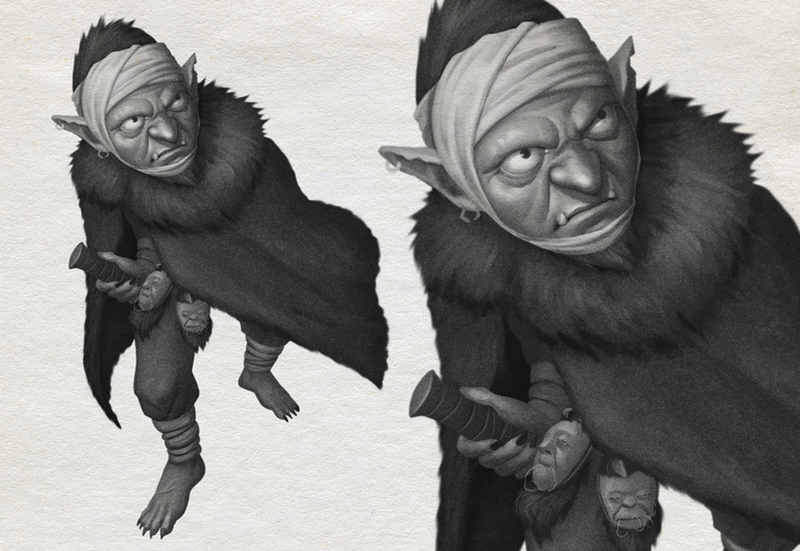
I'm almost giving up on shrinking this huge head and turning it into a shelter for my collection.

- Taliok Manto Negro, greatest bounty hunter of the Northern Empire. He collects specific objects like all goblins, in his case, the heads of fallen enemies. Currently trying to shrink the head of a dragon, payment for services rendered to the Boreal Crown.


Goblin (Ghara)


     Ghara's goblins are eccentric, creative, cunning and independent people. These beings have an easiness to adapt to the most diverse and adverse situations, using little resources. They like to solve problems and often boast of their garish solutions: " what matters is that it was all okay at the end."

     Goblins live squeezed among families of dozens, in an eternal mess. Due to this, they easily become used to rowdy places and even feel affinity with the mess (whether their or of others). As k a goblin to count all the silver of a dragon's hoard and he will do it with the precision of  a genius, even if he might restart many times, just to "be sure".

     It is speculated that this behavior is like a certain "organized insanity" which is adapting to their new life as civilized beings. Whatever the reason, their way of seeing things is often useful, even in a life of adventures, where challenges are put on their way all the time.

  • Ability Score Increase. Your Intelligence score increases by 1.
  • Speed. Your base walking speed is 25 feet.
  • Age. Goblins reach maturity at about twelve years old, and may live up to fifty years.
  • Size. Goblins average about 3 feet tall and weigh about 40 pounds. Your size is Small.
  • Investigation Proficiency. All goblins are proficient on the Investigation skill.
  • Nimble escape. You can use disengage or hide as a bonus action.
  • Goblin Tinkering. You know how to improvise and believes that not always (almost never) the perfect resources will be available to overcome challenges. Once very short rest you may use objects on sight to improvise a weapon, tool or even protection. Under the GM's discretion, you may use trinkets and other things you carry with you (or your group).
    • When using this ability, choose one: you create a melee weapon which causes 1d6 points of damage, either bludgeoning, piercing or slashing damage, and has up to one propriety; or a ranged weapon with range 30/60 feet, which causes 1d6 points of either slashing, bludgeoning or piercing damage, up to a single propriety and ten projectiles; or a light armor which gives AC 12 + Dex modifier; or an improvised tool which allows you to apply your proficiency into a single relevant ability check.
    • Any created weapons and armors usually last a single encounter (or one minute) before becoming useless, but could last longer depending on their usage and maintenance. A tool lasts until the end of an encounter, or one minute, or after being used (independent of success or failure int he respective roll)
    • You must search new objects and materials to use this ability again. You may not recycle the same materials.
 

Hobgoblin (Ghara)


     These beings group themselves in different tribes lead by the most wise and protected by the most brave and capable warriors. The hobgoblins developed their mastery of ranged weapons to such a point that they're as feared as an elf archer hiding on the woods (the elves obviously deny it). True or not, it is clear that there is a rivalry between these races which often end up occupying the same roles in peace and war. Open conflict between both are rare, at least mortal ones.

     Hobgoblins are proud of their ancestors, seeking the wisdom of these spirits which constitute the "racial soul" to solve problems. The only thing which might offend a hobgoblin more than insulting his family (and this includes the animals which which he shares space) is offending his ancestors.
  • Ability Score Increase. Your Wisdom score increases by 1.
  • Age. Hobgoblins age in a similar fashion to humans, reaching maturity by the time they're 16 and living as much as them.
  • Size. Hobgoblins are about the same size as humans, ranging from 5 to 7 feet tall. Your size is Medium.
  • Speed. Your base walking speed is 30 feet.
  • Ancestors' Omens. You have the ability to briefly communicate with the ancestral spirits of your race, to ask advice in your journeys. You start by performing a ritual hunt. You decide what you'll hunt, usually depending on where you are (you may try to hunt a beast in the woods, or even a rat in a dungeon). At the end, the hunt's result will provide you with clues about a future event or action.
    • This ability works exactly as a ritual version of the Augury spell (including the cumulative percentage of obtaining a wrong answer). However, it always last 10 minutes and the result for your doubts will come through the results of your hunt. For example, instead of simply receiving the Woe omen, you might have a bad feeling upon focusing about the way the blood drops from the carcass of the fallen animal.
  • Skill Proficiency. You are proficient with the skill Survival.
  • Wildcunning. Whenever you make an Wisdom (animal handling) check related to wild animals, you are considered proficient in the animal handling skill and add double your proficiency bonus to the check, instead of your normal proficiency bonus.

*Portuguese in real life.
**Basque in real life.

sexta-feira, 14 de setembro de 2018

Feidarash, the dark elf of Atma

Not all elves live isolated from the world in in the top of giant trees or mystical forests. Some believe that after spending so much time imprisoned by the fairies one should enjoy his liberty, spiritual and physically. Feidarashes, Ghara's dark elves, inhabit many places, including urban ones, and are more eclectic towards other people and races. Some superstitious individuals still see them as a sign of problems, however. 


During the pirilampo's mating season, there are no vacant rooms, and it is hard to sleep when the entire city becomes as bright as if the sun and the stars loved each other. There are so many surprises that some are truly unexpected.
- Lady Vernalagnia Alusif, Senior Madame of the Guilde des Affections Fuyantes, the courtesan's guild of Vieelvier (oldest of imperial mangrove-cities); the most famous feidarash in the whole empire; matchmaker; Melucia's priestess, tailor; courtesan; dance teacher; chakram fighting master.


Frivolous and Bold


     Physically, the dark elves are almost identical to their nearest cousins, the feidralin. But their skin is dark as ebony, sometimes being a dark grey. Their hair is often white, but many feidarashes use pigments to dye them in pleasing colors (or just to shock other people, mainly feidralin). Their behavior also differs. They don't usually value the traditions followed by feidralin so closely. Their free spirits believe that such atitude just limits the great blessing of freedom they gained in the past. This way of thinking also extends to laws, and, in a few cases, rules, values and social taboos. This "free spirit", together with the curse they are able to induce, makes many think of the dark elves as bringers of problems and bad luck.


The Fairy Curse


     Just like the Elven Exodus itself, the moment that elves became free of their fey lords, the creation myth of feidarashes has many variations, even among the race itself.

     One of the most common tales is that, during the great rebellion of the elven race, only some of them fought against the fairy tyranny. These ancient elves were the ones which planned their escape and even the development of writing itself, the weapon used by them to be masters of their own fate. While most of them escaped, these first rebels were cursed by the fey. They had their skin marked so that they would always remember their "mistake". Some feidarashes say the color of their skins was due to a dark humour of their fey masters, for it was the same color of the first phrases they marked on parchments. This curse also would bring disgrace to any that touched them, isolating them from potential allies. Through the ages, the dark elves learned to adapt. They accepted the way they were marked and now are even proud of the reminder of what they accomplished. They also learned how to control their touching curse, becoming able to choose when to use it. More than the colors and the fey curse, some feidarashes ascribe their thirst for new experiences and curiosity to the fey, saying that this is their true curse. The subject is a controversial one, but the dark elves don't seem inclined to seeking the truth. A complication of this matter is that assuming mortal forms was like the awakening of a deep dream, hazy and hard to remember precisely. As many of them say, what has passed, has passed. 
 

Locais de Importância:


  • Viellvier - Perhaps the world's oldest seaport, raised in an estuary where the feidarashes say they disembarked after escaping from Numeria. It is now a barony where the Northern Empire produces its best ships. The countless docks and shipyards are the stilt roots of a giant mangrove tree which drains salt water and separating it into clean water and salt for its inhabitants. Individuals and merchandises from all over the world go through here every day. About half the population are feidarashes. Many are courtesans and courtiers, the profession of a tenth of the three hundred thousand inhabitants. Instead of lamps or torches, the city is kept alight by domesticated giant pirilampos, both adult bugs as well as larvae hanging from the mangrove by silk threads. The baron's power is contested daily by the local guilds and owners of merchant fleets.
  • ArdenellieThe Sycamore's duchy capital is a grove of giant fig trees intertwined in Feidr's central plains. The elven trees are as high as cathedrals and as large as cities, Many roots coming out from the branches form secondary and yet huge trunks. Some of the hundred thousand citizens are so dedicated to the trees that they hardly step on the ground. Most of the houses are hanging onto the truss of branches, silk ropes and vines. Ardenellie produces the most food on the entire Feidr region. A council of elders and guild masters manages the city. Most of the population is feidalin, but one of five inhabitants are feidarashes.

  Feidarashis Traits


  • The dark elves from Ghara are unlike the dark elves of D&D and form its own unique race.
  • Ability Score Increase. Your charisma score increases by one.
  • Age. Dark elves reach physical and mental maturity at about 20 years old. Like the feidralin, they may live as long as 700 years, maybe more. However, their memories aren't any better than a human's, so very old elves hardly remember most of their lives.
  • Alignment. The feidarashes consider themselves free and don't like the rigidity of law and rules. Because of this, a dark elf has strong tendencies towards the chaotic alignment. They don't have any particular leaning towards good or evil.
  • Size. Dark elves range from under 5 to over 6 feet tall and have slender builds. Your size is Medium.
  • Speed. Your base walking speed is 30 feet.
  • Sidhe Curse. As an action you may curse a target up to 30 feet away that you might see with the power of the fey lords. The target must roll a Charisma check, DC 8 + your proficiency value + your Charisma modifier. If it fails, the target suffers, until the end of its next turn, a penalty on its rolls of attack, damage, ability, skills and saving throws equal to your proficiency value. If the target succeeds, you don't spend your use of the Sidhe Curse (and may try again if you wish). Creatures immune to enchantment effects can't be affected. A creature affected by the Sidhe Curse can't be affected again by the Sidhe Curse of any and all feidarashes during the next 24 hours. After affecting a creature, you must have a long rest before using this power again.
  • Feidarash weapons training. You are proficient with rapiers, short swords and chakrams.

quarta-feira, 29 de agosto de 2018

Lilims

From the city's dark corners, mysterious creatures watch the constant passage of others. Even without seeing them, they can understand the mind spectrum of every individual passing through the streets above. The world through their eyes is like a labyrinth made of logics only they can solve.


Half Humans Half Nefilims


     Nefilims are abyssal entities extremely voracious, devouring everyone and everything, parasitizing what's left. Diverse in shapes and sizes but always hideous. The Nefilim Invasion was a cataclysm which decimated the entire planet centuries ago. There are lifeless and grayish places which never recovered. The largest and better known are the Unquiet Lands, so called because its borders expand and contract from time to time. During the invasion, a nefilim entity called Lilith wished to have offspring. Incorporating countless women on itself, generated something that wasn't nefilim but also wasn't human: lilims.

     Despite the fusion of nefilim traits with the body and soul of mortals, lilims have desires, thoughts and needs similar to humans. They thirst for relationships which are made difficult for three reasons, all the result of their demonic heritage: the disturbing appearance; the difficulty of comprehending feelings, both theirs and of others; the face which hardly expresses what they feel. Were it not for the fact that Dhalila, the goddess of sacrifice, adopted the race, they might have not survived. She taught them to use logic to deal with the world and people.


Prejudice and Fear

     A lilim is seen, at the very least, as a strange creature. Due to this, most individuals fear and mistrust lilims, marginalizing them. Lilims are seldom found in cities, but they manage to acquire some respect in more developed places. For example, the empire's capital houses little more than a hundred lilims. They founded an ethnic guild, in an attempt to band together and feel how it would be to have their own society. Lilim communities almost never exceed this size, both because they are few compared to the other races, as well as to avoid being used as scapegoats for any problems the region might have. An organization called Lazarus Order helps them with forming isolated villages throughout the empire and outside of it. They say that there are cities with thousands outside the empire and in other nations, perhaps even nearby the Unquiet Lands, where no race or civilization dares to colonize.

Place

  • Coeus Ossuary: a citadel of five thousand people near the Unquiet Lands, but still within the Northern Empire. The population, mostly lilims, mine the bones of an old titanic god consumed by nefilims during their invasion. Besides serving as raw materials for weapons and armour, the bones are used to reinforce important structures such as the Imperial Palace and some fortresses. The urban aspect is unsettling: houses raised among ribs as long and large as avenues; the mayor lives inside a skull as huge as a castle; vertebra's shards used as columns. Despite this, the bones are harmless. The danger are the occasional nefilim attacks trying to gnaw the bones to reach their marrow, which has useful alchemical properties.

Lilim Traits

  • Ability Score Increase. Your intelligence value increases by 2 and another ability of your choice increases by 1. Lilims have powerful minds due to their supernatural lineage.
  • Age. Lilims mature and live at the same rate that humans.
  • Alignment. Lilims tend toward no particular alignment.
  • Size. Lilims are considered Medium size creatures, usually have thin builds and their height varies from 6 feet to 7 feet tall.
  • Speed. Your base walking speed is 30 feet.
  • Dreadful. You have proficiency in Intimidation. Besides their strange appearance, lilims learned to analyze others through observation and use it to manipulate one's fears. However, most of them use this as a defense mechanism.
  • Nefilimcunning. Whenever you make an Intelligence (arcana) check related to nefilims, you are considered proficient in the arcana skill and add double your proficiency bonus to the check, instead of your normal proficiency bonus.
  • Mental intrusion. Once per long rest, the lilim may attempt to invade someone's mind up to a 30 feet distance. He makes an insight check against the target's intelligence. If the lilim suceeds, he learns a secret kept by the target, determined by the DM. Any target immune to charming or psychic damage is also immune to this trait, as well as creatures whose Intelligence value is 2 or less.
  • Omniphagia. Once per long rest, the nephilim may attempt to absorb the essence (prana) of an object or creature. To do so, he needs to touch it. If it is a creature, the target must roll a Constitution saving throw (DC 8 + lilim's proficiency + Intelligence modifier). If the target fails, this causes force damage equal to the lilim's level (half if the creature succeeds at the test. The lilim recovers a corresponding number of hit points. When used in objects, it always causes half damage. Creatures and objects affected by this ability present flaky and grey surfaces or skin.