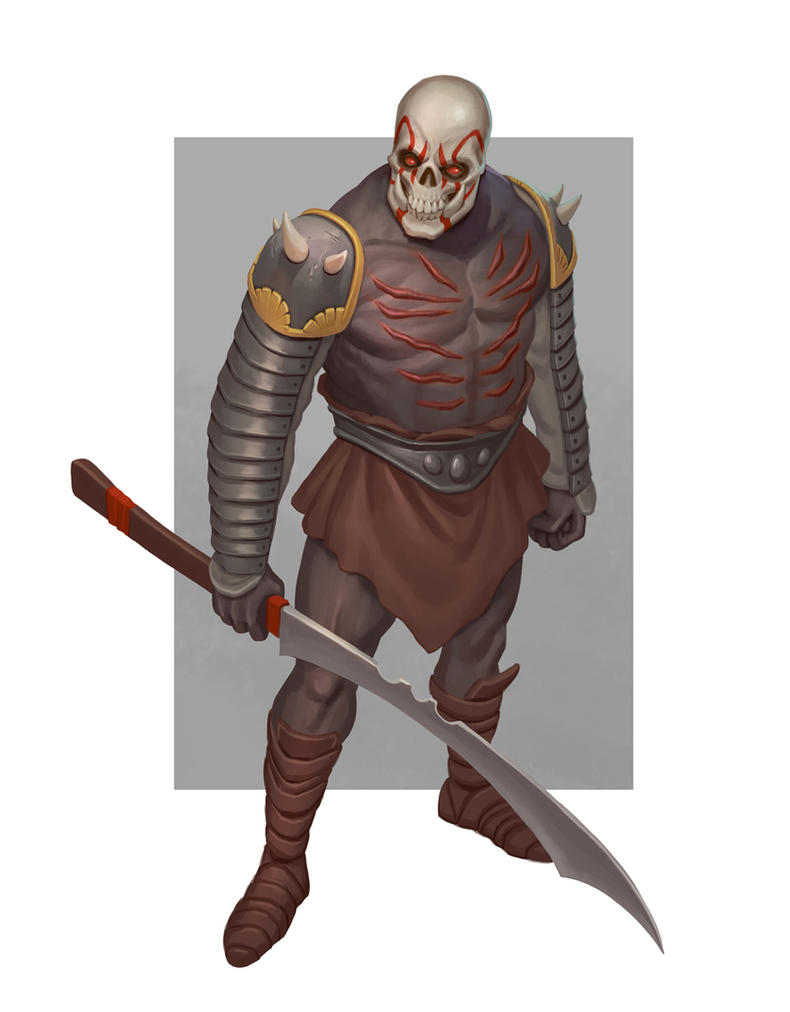
Enslaved and oppressed by fallen empires. Classic and eternal enemies of adventurers and civilization in the present. The goblinoids went through a great change after the end of the Retaliations War, changing the perspective of their future.
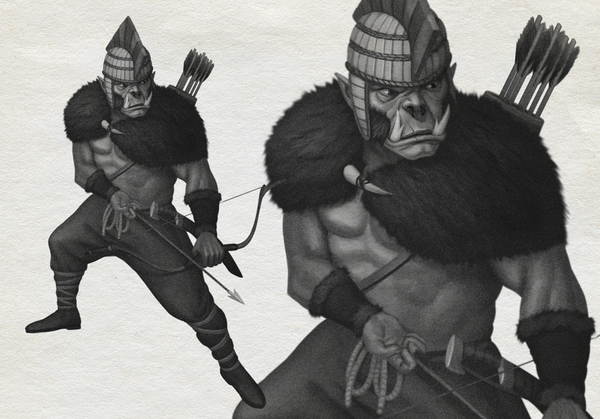 |
| You are a mighty beast, but these people won't be your prey. Barkatu, agur. -Makhila Segovax, hobgoblin hunter renowned in the empire, among goblinoid tribes, and beyond. |
Challenges of the Past
Hobgoblins and goblins appeared almost at the same time, due to the actions of the great Idura. The first became a physical race after Idura conquered a fairy forest, a feast which awakened a rage into the Royal Ents. The revenge was terrible for some: for many years, children throughout the world were born with traits similar to the newly appeared hobgoblins. The goblins descend from these fusions of mortal and fey.
The loathing of "civilized" people only increased when the goblinoids were enslaved in great numbers by the Amaranthine Empire. Centuries of oppression fed rebellions helped by an invention originated from the many herds they were forced to take care of: the composite bow, a mixture of wood, horn and sinew which could pierce the armour of their masters. The Northern Empire, which sees itself as successor of the amaranthines, still blames the goblinoids for the destruction of their ancestors. The truth is more complicated, for the old empire had more troubles than the goblinoids rebellions. Guided by the wisest goblinoid ethnicity, the maubor, goblins and hobgoblins carved the former imperial lands into the domains of countless tribes. Centuries of tribal conflict happened since then. The Northern Empire acquired millions of goblinoid slaves, many sold by other goblinoids.
In 1390 Post-Idura, a foreigner calling himself Lord Pain united them under a single banner, defeating tribes and assimilating them under a mix of army and migration. More than two hundred thousand warriors and their families invaded several regions of the Northern Empire, by land and sea. The following Retaliations War lasted from 1399 to 1402. The name comes from the fact that both sides saw it as an answer: goblinoids wanted to punish those arrogant imperials which repeated the mistakes of their predecessors, imposing an order and civilization which saw the "barbarian people" as inferiors; the Northern Empire considered the war as a revenge against those which had destroyed the glorious Amaranthine Empire. Against all expectations, the war ended on a peace treaty in which most of the slaves throughout the empire were freed. Since then, most of the goblinoids went back to the southern lands, forming cities and tribal confederations, for they learned how strength comes from union. Many settled in areas of the empire while others, mostly former slaves, became imperial citizens. The consequences of such changes still occur in the Goblinoid Lands and the northern fiefs.
Heroes of the Present
Nowadays, with the migration of huge numbers of goblinoids into the imperial social classes, their presence is as common as many other races in the urban scenery.
Goblins find it every easy to join the urban labyrinth of the big cities, and one can find them in the rumble of the markets as well as the dark alleys. Some even show talent beyond expectations and conquer greater status, as business owners and even nobles (although, in human cities, goblin nobles are still rare). Most are obsessed with collecting some kind of item: spoons, parts of defeated enemies, pretty rocks etc. Some prefer more abstract things, like stories and friendships. The sought after item usually determines the goblin's profession and attitude. A rogue may simply seek opportunities to gather padlocks, a shoemaker wants to use every possible type of leather for his shoes.
Hobgoblins don't appreciate the confusion of cities. They seem satisfied with occupying the woods and jungles, devoted to nature, spiritism and ritualism. The oppression that the so called "civilized" people caused them still weighs on their racial soul. But they still found their place as hunters, shepherds, veterinarians and archers, specially in the imperial army. The huge majority of them believes that every individual has a spiritual brother, usually an animal which was born close to the hobgoblin tribe and roughly at the same time. The "animal-brother" is seen as a family member and a guardian: someone which is always watching and reminding one to walk the right path with this new chance.
Due to all this, of course, the goblinoids wouldn't be different from the other races with which they share ground on Ghara and adventurers aren't unusual. Adventuring parties with goblinoid members, or even entirely formed by goblinoids, have become a more frequent sight. Some even got a certain renown similar to local heroes. It is becoming ever more likely that there are legendary members, like those of other races, decorating the statue rows in the cities.
Goblins find it every easy to join the urban labyrinth of the big cities, and one can find them in the rumble of the markets as well as the dark alleys. Some even show talent beyond expectations and conquer greater status, as business owners and even nobles (although, in human cities, goblin nobles are still rare). Most are obsessed with collecting some kind of item: spoons, parts of defeated enemies, pretty rocks etc. Some prefer more abstract things, like stories and friendships. The sought after item usually determines the goblin's profession and attitude. A rogue may simply seek opportunities to gather padlocks, a shoemaker wants to use every possible type of leather for his shoes.
Hobgoblins don't appreciate the confusion of cities. They seem satisfied with occupying the woods and jungles, devoted to nature, spiritism and ritualism. The oppression that the so called "civilized" people caused them still weighs on their racial soul. But they still found their place as hunters, shepherds, veterinarians and archers, specially in the imperial army. The huge majority of them believes that every individual has a spiritual brother, usually an animal which was born close to the hobgoblin tribe and roughly at the same time. The "animal-brother" is seen as a family member and a guardian: someone which is always watching and reminding one to walk the right path with this new chance.
Due to all this, of course, the goblinoids wouldn't be different from the other races with which they share ground on Ghara and adventurers aren't unusual. Adventuring parties with goblinoid members, or even entirely formed by goblinoids, have become a more frequent sight. Some even got a certain renown similar to local heroes. It is becoming ever more likely that there are legendary members, like those of other races, decorating the statue rows in the cities.
Goblinoid Traits
The goblinoids share the following traits:
- Ability Score Increase. Your Dexterity score increases by 2.
- Darkvision. Accustomed to twilit forests and the night sky, you have superior vision in dark and dim conditions. You can see in dim light within 60 feet of you as if it were bright light, and in darkness as if it were dim light. You can't discern color in darkness, only shades of gray.
- Stealth Proficiency. All goblinoids are proficient on the Stealth skill.
- Languages. Goblinoids speak, read and write in Common* and Goblinoid**, using the common alphabet. The goblinoid language has many sharp consonants which often express more through their sounds than their literal meaning.
- Ethnicities. Next is a brief description of the two most common ethnicities in Ghara: goblins and hobgoblins.
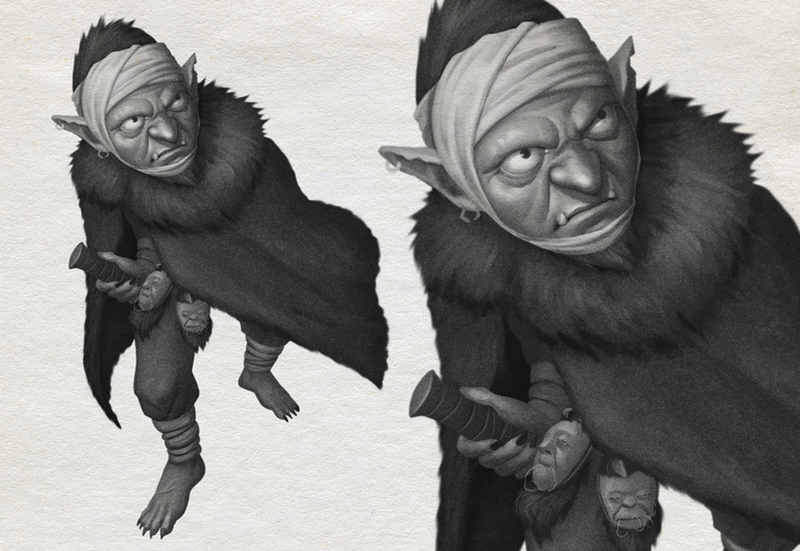 |
| I'm almost giving up on shrinking this huge head and turning it into a shelter for my collection. - Taliok Manto Negro, greatest bounty hunter of the Northern Empire. He collects specific objects like all goblins, in his case, the heads of fallen enemies. Currently trying to shrink the head of a dragon, payment for services rendered to the Boreal Crown. |
Goblin (Ghara)
Ghara's goblins are eccentric, creative, cunning and independent people. These beings have an easiness to adapt to the most diverse and adverse situations, using little resources. They like to solve problems and often boast of their garish solutions: " what matters is that it was all okay at the end."
Goblins live squeezed among families of dozens, in an eternal mess. Due to this, they easily become used to rowdy places and even feel affinity with the mess (whether their or of others). As k a goblin to count all the silver of a dragon's hoard and he will do it with the precision of a genius, even if he might restart many times, just to "be sure".
It is speculated that this behavior is like a certain "organized insanity" which is adapting to their new life as civilized beings. Whatever the reason, their way of seeing things is often useful, even in a life of adventures, where challenges are put on their way all the time.
- Ability Score Increase. Your Intelligence score increases by 1.
- Speed. Your base walking speed is 25 feet.
- Age. Goblins reach maturity at about twelve years old, and may live up to fifty years.
- Size. Goblins average about 3 feet tall and weigh about 40 pounds. Your size is Small.
- Investigation Proficiency. All goblins are proficient on the Investigation skill.
- Nimble escape. You can use disengage or hide as a bonus action.
- Goblin Tinkering. You know how to improvise and believes that not always (almost never) the perfect resources will be available to overcome challenges. Once very short rest you may use objects on sight to improvise a weapon, tool or even protection. Under the GM's discretion, you may use trinkets and other things you carry with you (or your group).
- When using this ability, choose one: you create a melee weapon which causes 1d6 points of damage, either bludgeoning, piercing or slashing damage, and has up to one propriety; or a ranged weapon with range 30/60 feet, which causes 1d6 points of either slashing, bludgeoning or piercing damage, up to a single propriety and ten projectiles; or a light armor which gives AC 12 + Dex modifier; or an improvised tool which allows you to apply your proficiency into a single relevant ability check.
- Any created weapons and armors usually last a single encounter (or one minute) before becoming useless, but could last longer depending on their usage and maintenance. A tool lasts until the end of an encounter, or one minute, or after being used (independent of success or failure int he respective roll)
- You must search new objects and materials to use this ability again. You may not recycle the same materials.
Hobgoblin (Ghara)
These beings group themselves in different tribes lead by the most wise and protected by the most brave and capable warriors. The hobgoblins developed their mastery of ranged weapons to such a point that they're as feared as an elf archer hiding on the woods (the elves obviously deny it). True or not, it is clear that there is a rivalry between these races which often end up occupying the same roles in peace and war. Open conflict between both are rare, at least mortal ones.
Hobgoblins are proud of their ancestors, seeking the wisdom of these spirits which constitute the "racial soul" to solve problems. The only thing which might offend a hobgoblin more than insulting his family (and this includes the animals which which he shares space) is offending his ancestors.
- Ability Score Increase. Your Wisdom score increases by 1.
- Age. Hobgoblins age in a similar fashion to humans, reaching maturity by the time they're 16 and living as much as them.
- Size. Hobgoblins are about the same size as humans, ranging from 5 to 7 feet tall. Your size is Medium.
- Speed. Your base walking speed is 30 feet.
- Ancestors' Omens. You have the ability to briefly communicate with the ancestral spirits of your race, to ask advice in your journeys. You start by performing a ritual hunt. You decide what you'll hunt, usually depending on where you are (you may try to hunt a beast in the woods, or even a rat in a dungeon). At the end, the hunt's result will provide you with clues about a future event or action.
- This ability works exactly as a ritual version of the Augury spell (including the cumulative percentage of obtaining a wrong answer). However, it always last 10 minutes and the result for your doubts will come through the results of your hunt. For example, instead of simply receiving the Woe omen, you might have a bad feeling upon focusing about the way the blood drops from the carcass of the fallen animal.
- Skill Proficiency. You are proficient with the skill Survival.
- Weapon Training. You are proficient with short bows, short swords, falcatas and komatai bows.
- Wildcunning. Whenever you make an Wisdom (animal handling) check related to wild animals, you are considered proficient in the animal handling skill and add double your proficiency bonus to the check, instead of your normal proficiency bonus.
*Portuguese in real life.
**Basque in real life.