Mostrando postagens com marcador gods. Mostrar todas as postagens

domingo, 28 de abril de 2019

The Origins of Kahonua and Kosinbia

  Sacrificing yourself for the greater good is a virtue. Dying for nothing is a sin. -Amanirena “snake-cutter” Thákame, herald and prophetess of Kahonua. Prayer of Moto Mapokeo Ya (Fire Folklore), Volume Five.


     Why Kahonua and pyromancers are so important on Kosinbia, to the point that the region despises and even vilifies another ways of magic and other gods? It is because the very idea of "Kosinbia" was born through the pyromancers and the volcano goddess.
     
     The whole region was once divided into countless tribes and groups which could share things such as language, race and difficulties, but didn't saw themselves as equals or part of something greater. In fact, the most common trouble for all were the rivalries and fighting with neighboring tribes.

     In this fragmented world, there were two nomad tribes, unique and somewhat accepted by all:


  • Oayas, predecessors of the pyromancers, were as respected and feared as witches, shamans or wizards, bringing troubles and solutions in equal measure. They worshiped the zebra-goddess Nuami, one amongst many other deities exclusive of one tribe or another. Their blend of supernatural martial art and ritual dance was based on zebras fighting, and practiced in the surroundings of volcanoes.

  • Khayas were iron miners and traveling blacksmiths. But because they kept their techniques to themselves, they were mystified by the other tribes, for they knew how to "turn the earth into spears and swords". Their totem was the termite, called Kahomi, for the clay of the termite hives was one of the secrets used to make their furnaces.

     Both groups had no affinity between themselves. Sometimes, a child of the Khayas was sent to the Oayas for their family thought she had a talent for pyromancy and vice versa. This was common among all the tribes which specialized into an art or craft and had youngs which didn't fit for one reason or another, many of which had nothing to do with talent: a benign way to exile the "black sheep" of the community.

     This was the origin of the future prophetess Amanirena Thákame. She was born among the Khayas, but was taken to the Oayas after her parents died in an orc attack which also prevented her relatives from raising her. The girl wasn't killed in the attack because she managed to throw the orc which killed her parents into the furnace they used. It was seen as a sign that her future was tied to fire.

     Being a teenager when she entered the pyromantic tribe, her perspective ended up being a mixture of a blacksmithing childhood with flaming maturity. In some uncertain moment she defined the idea of union among people hostile to each other, but which knew how to speak and love, against a greater evil: the orcs.

     The oral folklores offer several versions for how she united the two tribes in such a way, that the deities themselves fused into a new goddess which mixed fire and earth into the symbol of the volcano, Kahonua. The romantic version is that she managed to do a wedding ritual for a couple of gods which already loved each other from far away; the most mundane version claims she impressed the blacksmith tribe with a fire so hot it could make steel and the pyromantic tribe when she produced "fire from stone", gunpowder, and thus convinced both how the whole could be more than the mere sum of its parts; another version speaks that she married or got involved with important men on both tribes, influencing them through such men; there are also versions more sordid or peaceful, tragic or mystic. Perhaps those sages which try to rebuild the facts by merging the many versions are closer to the truth.


     What is clear is that she started to lead a nomad alliance which used steel and fire as carbon steel blades, martial arts tempered with impressive magic and something completely new, the first firearms. Primitive cannons and handgonnes, cast in iron and bronze, using a mixture that, perhaps, no one would have discovered without the cultural and religious motivation for it: gunpowder. It was hard to counter the argument that union brings strength when the result breaches stone walls, scares men and animals, kill orcs before they touch you and can be used by anyone with minimal training.

     However, Amanirena didn't use firearms. She wielded the spear Wachumatu and the machete Nyoka-Auaye, both made from the iron which was left in the furnace into which she pushed the orc which killed her parents, now shaped as red-hot blades. The prophetess taught that kill someone was a waste, for a life may and must be sacrificed only for the greater good. Punishments were another matter. With her incandescent blades, she cut and cauterized criminals: fingers, ears and other parts which the guilty had to learn to live without. Executions happened only when someone committed so many crimes that there were no parts to cut anymore.

     Thirty years later, she unified the tribes, organized them into principalities, instituted the amani tradition and began the construction of the Sacrificial Bastions. When her duty was fulfilled, came the reward: the goddess of fire and earth turned her prophetess into the first Nyokakuba, mother of all the others. And in this shape Amanirena lives until today in her nest, the sacred volcanic caldera called Kahonuterasi.

sábado, 27 de abril de 2019

Dhalikastra

I saw a forest made of trees whose roots were made of hundred of fingers, each one with a thousand knuckles; sprouting eye-fruits and ear-flowers; trunk with a bony bark and teeth instead of thorns; great locks of hair in place of leaves.
 -Litua Kortos, lilim of the Dhalikastra's garrison.

     This fortress' role has been to lure nefilims for the last four hundred years, drawing the evils of the Unquiet Lands. If something conquers it one day, the garrison has the duty of warning the world of this. Dhalikastra is shaped as a titanic hexagonal prism, red and bright amidst a land of an opaque, dead grey. The radiance pours out of the goddess Dhalila herself. It sustains, protects and heals the defenders, at the same time attracting nefilims like ants seeking sugar. And when they come, the guardians gather in walled balconies and shoot from arrowslits, protected by heavy adamantine armors. The latter are reinforced with leather and cloth to portect their users from the toxic elements and the ocasional vacuum of the Unquiet Lands. Every helmet must have a glass-sap visor and miasma filters.

    The current castellan is Volya "Smeyas". A blond shardokan, with dark circles under his eyes and grey spots in the arms, wielding a flintlock grenade launcher. Like all which stay here, he adopted a new name for a new life, leaving his old self outside the Unquiet Lands and the terror that they create:
My babuskha, Valeria, told me how the man she loved was attacked from within his own guts, and how she had to kill what was left. She told me of a voyage which lasted a year more than it should, being awakened in the midnight by a feeling of pain and finding saliva and bite marks where it hurt. May Corallin forgive my baba for burning down a forest to escape the Thing That Laughs. When baba died, I sacrificed ten sheep to Corallin so her soul would reincarnate into a better life. Then I came here. Volya means "freedom". I spent my entire life afraid of the stories about the terrors and carnages she saw. I was tired of being afraid, of being a victim of these bastard things with larval teeth. Now, even amidst this hell, I'm happy. You can't imagine how good it feels to be free of the fear which was more intimate to me than my own parents. My nickname here is Smeyas, which means "the one which laughs", because I can laugh in the worst situations. Half of it is due to despair, the other half for the happiness in finally reacting upon my fears, all of it for the chance of exploding a nefilim.

     Like Volyas, most of the defenders had their life marked by nefilims in one way or another. Many came from exile colonies for those which suffer from nefilim leprosy, administered by the Lazarus Order.
Anyone may be a volunteer, no matter the race, beliefs, crimes or status. As much honor as can be had among men and gods, amidst enemies on the battlefield, there can be no honor nor peace among mortals and nefilims. The lilims themselves agree with this. We're all equal when facing nefilims, just food and fun for them. They will regret teaching us to be equals.
     Here also lies an observatory meant to identify nefilim falling nests and the place of their crash. Most of the nests come from the Gharian Planetary Ring, therefore having rich adamant veins. Dhalikastran expeditions depart to eliminate the infestations and claim mining rights over these asteroids. Part of the extracted adamant goes to Dhalikastra. The rest is sold to sustain the exile colonies and the cult of Dhalila.

quinta-feira, 30 de agosto de 2018

Beli-vuskha


     It is said that beli-vuskhas are no more than the fantasies of lonely shardokans. Staying alone for many years, hunting, cutting ice or looking for veins of ore can make someone imagine many things to stop the silence.

     This has a kernel of truth, if one thinks of the most popular story to explain their existence: that even before the empire came to be, one or more isolated mountain dwarfs carved ice women which gained life thanks to Corallin's powerful benevolence. They were cold to the touch, but that wasn't a problem for a race that can survive a snowstorm with nothing more than a loin-cloth. The new couples became families united into a new clan, called Katusha.

     the clan prospered for hundreds of years, although it became clear that the descendants of shardokans and beli-vuskhas can only be beli-vuskhas. Even after burying the bodies of their loved ones, the immortal matriarchs kept living with their daughters in a citadel called "Katusha". The beli-vuskhas must remain in the highest mountains to escape from melting. And while many fear the cold and possible hunger during the winter, these ladies love the opportunity to go to the lower lands and talk with their inhabitants, to relieve the loneliness and even find love. In the case of danger, they can cause hypothermia with a touch, shoot ice projectiles and winds strong enough to raise someone off the ground.
 
     Another tale told among the shardokan is about the beli-vuskha Katusha Aniyu. This snow adventuress can be distinguished by her plae skin, sapphire colored eyes and wavy hair blue like the sea. She's always dressed in a thick bear skin with colorful beads. Fragments of eternal ice on the inside allow Aniyu to travel beyond her sisters. Her goal is to acquire a fortune and buy so much eternal ice that she and her sisters may live anywhere they want.

sábado, 25 de agosto de 2018

Nyokakuba

Kahonua, warm earth-mother, fire of soul, great rich land, mistress of volcano.
May thy Holy Fetiches protect my tribe and evaporate evil.

-Prayer from the Moto Mapokeo Ya (Fire Lore), Book Twelve.

      The fourteen divine wyrms of Kahonua: magma for blood; scales of granite and dazzling corundum; head armoured in obsidian; metal-melting breath; but its greatest power is to give divine authority to the princes, so they may rule their respective kosinbian principalities. To each one a divine serpent is given, and the two remaining nyokakubas guard the holy city, Kahonuterasi. Following the latter's example, the capitals of each principality were built around a volcanic caldera that serves as a nest to the respective goddess' blessing. When a new prince takes over, the nyokakuba changes its skin. The old scales are then crushed into a dust to cover the new prince, making him capable of surviving any heat and physical contact with the wyrm that marks him in the way a crown marks foreign kings. However, only a small part of this dust is used; the rest stays under the prince's control, which he gives as a reward to the heroes and champions which benefit his principality.

Nyokakuba

Gargantuan celestial, neutral lawful

Armor Class 24 (natural armor)
Hit Points 615 (30d20 + 300)
Speed 50 ft., burrow 30 ft., climb 30 ft.

STR DEX CON INT WIS CHA
30 (+10) 16 (+3)   30 (+10) 12 (+1) 20 (+5) 20 (+5)

Saving Throws Str +17, Dex +10, Con +17, Wis +9, Cha +12
Skills Athletics +15, History +10, Insight +10, Intimidation +10, Perception +16, Persuasion +10, Religion +10, Stealth +8
Damage Resistances bludgeoning, piercing, and slashing from nonmagical attacks
Damage Immunities necrotic, poison, fire
Condition Immunities exhaustion, grappled, paralyzed, petrified, poisoned, prone, restrained, unconscious
Senses tremorsense 180 ft., passive Perception 26
Languages Common, celestial, kosinbian*, ignan, terran.
Challenge 27

  • Heat Aura. A creature that touches the Nyokakuba or hits it with a melee attack while within 20 feet of it takes 16 (3d10) fire damage plus 11 (2d10) radiant damage.
  • Illumination. The Nyokakuba sheds bright light in a 60-foot radius and dim light in an additional 60 feet.
  • Legendary Resistance (3/Day). If the Nyokakuba fails a saving throw, it can choose to succeed instead. 
  • Magic Resistance. The Nyokakuba has advantage on saving throws against spells and other magical effects. 
  • Magic Weapons. The Nyokakuba's weapon attacks are magical. 
  • Innate Spellcasting. The Nyokakuba's innate spellcasting ability is Wisdom (spell save DC 17, +11 to hit with spell attacks). It can innately cast the following spells, requiring no material components:
    At will: detect magic, sacred flame, continual flame, heat metal, cure wounds, shield of faith, fireball.
    5/day: tongues, conjure elemental (fire elemental or earth elemental only), wall of fire, prayer of healing, dispel magic, protection from energy, revivify.
    3/day each: invisibility, plane shift, commune, flame strike, sending, stoneskin, teleportation circle, contact other plane, dream, beacon of hope.
    1/day each: greater restoration, mass cure wounds, true resurrection, earthquake, incendiary cloud, gate.  

ACTIONS

  1. Multiattack. It makes two attacks: one with its bite and one with its tail.
  2. Bite. Melee Weapon Attack: +18 to hit, reach 15 ft., one target. Hit: 21 (2d10 + 10) piercing damage plus 16 (3d10) fire damage plus 11 (2d10) radiant damage. If the target is a creature or a flammable object, it ignites. Until a creature takes an action to douse the fire, the target takes 5 (1d10) fire damage at the start of each of its turns.
  3. Tail. Melee Weapon Attack: +18 to hit, reach 20 ft., one target. Hit: 19 (2d8 + 10) bludgeoning damage plus 16 (3d10) fire damage plus 11 (2d10) radiant damage. If the target is a creature or a flammable object, it ignites. Until a creature takes an action to douse the fire, the target takes 5 (1d10) fire damage at the start of each of its turns.
  4. Pyroclastic burst (Recharge 5-6). Ranged Weapon Attack: +11 to hit, range 200/600 ft., one target. Hit: 19 (2d8 + 10) bludgeoning damage plus 16 (3d10) fire damage plus 11 (2d10) radiant damage in a 30-foot-radius sphere. If the target is a creature or a flammable object, it ignites. Until a creature takes an action to douse the fire, the target takes 5 (1d10) fire damage at the start of each of its turns.
  5. Constrict. Melee Weapon Attack: +18 to hit, reach 10 ft., one creature. Hit: 37 (5d10 +10) bludgeoning damage plus 16 (3d10) fire damage plus 11 (2d10) radiant damage, and the target is grappled (escape DC 20). Until this grapple ends, the creature is restrained, and the Nyokakuba can't constrict another target. If the target is a creature or a flammable object, it ignites. Until a creature takes an action to douse the fire, the target takes 5 (1d10) fire damage at the start of each of its turns. 

LEGENDARY ACTIONS

The Nyokakuba can take 3 legendary actions, choosing from the options below. Only one legendary action option can be used at a time and only at the end of another creature's turn. The Nyokakuba regains spent legendary actions at the start of its turn.
Tail Attack. The Nyokakuba makes a tail attack.
Constrict Attack (costs 2 actions). The Nyokakuba makes a constrict attack.
Volcano (costs 3 Actions). Magma erupts from a point on the ground the Nyokakuba can see within 180 feet of it, creating a 20-foot-high, 10-foot-radius geyser. Each creature in the geyser's area must make a DC 16 Dexterity saving throw, taking 27 (5d10) fire damage on a failed save, or half as much damage on a successful one.


The nest of the nyokakuba in the principality of Danxome.

Where the holy serpent crawls, the soil becomes a flat trail of terracotta which 
serves as a road even if it isn't later paved with ceramics in the shape of scales.


*Swahili of real life.

sexta-feira, 24 de agosto de 2018

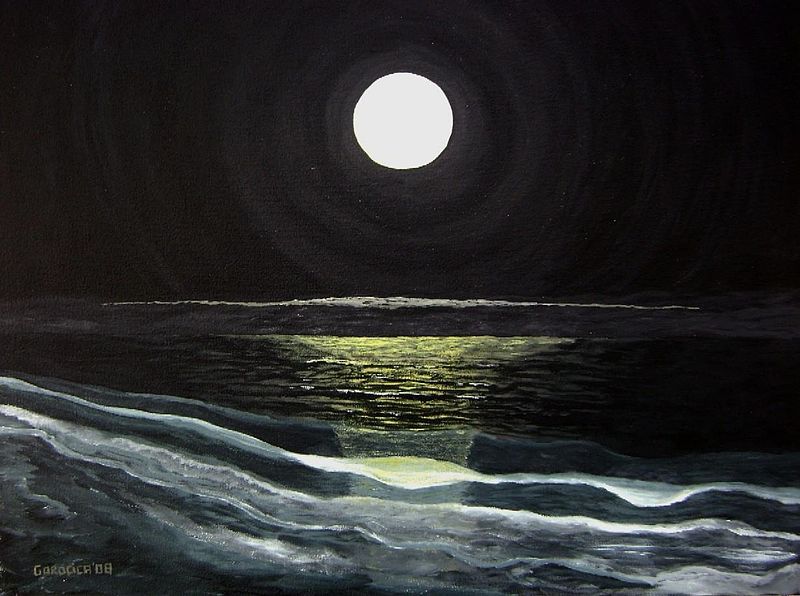
Nyxcilla, goddess of oceans and night

Salida Luna - Villa Gesell by BrunoKopte

Names and epithets: Queen of Darkness, Nyxcta,
Mana Mother, Dame of the Hidden Land, Thallassathea.
Alignment: CN Domains: Arcana e Tempest


544px-Pearl-variety hg by BrunoKopte
Symbol: Pearl.


    Nyxcilla rules the deep dark, from the abyssal waters to the night and moon. Through the tides from her lunar domains the world is bathed on magic. As suitable for the goddess of oceans, she is never still. Anyone at the sea may be judged as suits her wholesome and overwhelming temper. Diveus courts and calls for her through mortal messengers, but her answers are unknown, perhaps absent.


Maelstrom-Clarke by BrunoKopte
Mother-of-pearl, Nyxcilla's high priestesses, vouch for some
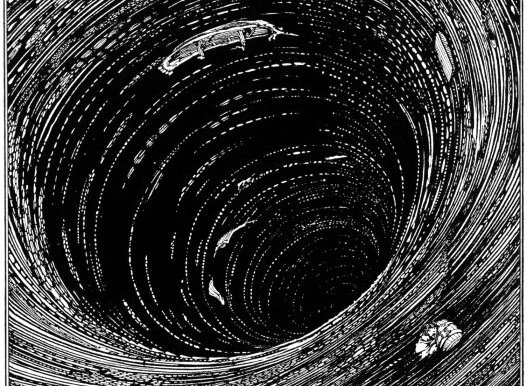
couriers being drawn into her whirlpool navel...

Descries dos prdios dentro de 2 by BrunoKopteDescries dos prdios dentro de 1 by BrunoKopte422px-Haeckel Phaeodaria 61 by BrunoKopte
...and brought to Finfolkaheem, the crystal palace.

    Her shape is of a gigantic mermaid, half graceful maiden, half sea serpent of lengthy tail, with tiny, rough and bluish denticles. Her long and flowing hair is a grove of kelp, guarded by honourable seahorses clad in cowry maille and handling spears with their tails. Long and translucent eyelashes, gilded with nematocysts. All her fan-like fins are endless, gradually clearing and bluing until they become sea currents.


449px-Curious mantis shrimp from Gilli Banta reef by BrunoKopte444px-Mantis shrimp from front by BrunoKopte
She always wears a scarf of webbed byssus, decorated with her greater mantis shrimp servants.

   
    From her shoal retinues, one can mention: Nereids, the goddess' daughters, riding the swift and colorful squids which protect their virtues; Selkies, eternally bound mermaids; Dobhar-chú, gulping tributes thrown into the sea by sailors, storing it inside transparent throat sacs; the whale choir which upon Nyxcilla's command, arouses the seas into storms or lull them into placidity, lead by sperm whales armoured with barnacles and spouting lightning.


Actiniaria by BrunoKopte
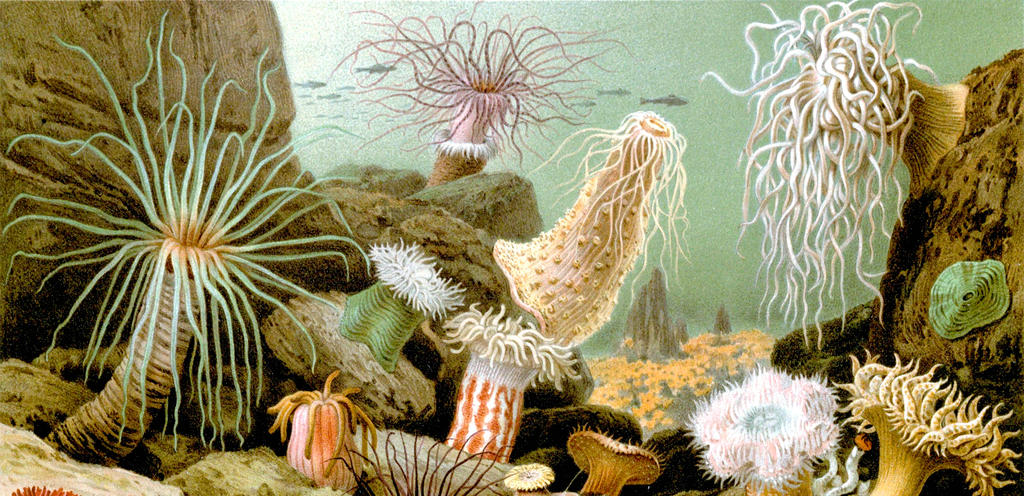
The retinue migrates along several sazonal palaces, towering sea anemones which use their tentacled battlements to collect sunken treasures, seeking gifts to Nyxcilla's delight, storing the rest in giant oysters. They are garrisoned by the Oceanids, descendants of amazons and lionfish, distinguished by the thorny and poisonous fins inherited from their fathers.

Wenceslaus Hollar - Shells (Turritella terebra and by BrunoKopteLoki's Lined Chiton (Tonicella lokii) (8185666946) by BrunoKopte
Oceanids wield kattars fashioned from conic seashells, and armor themselves with chiton cuirasses.


Bioluminescent dinoflagellates 2 by BrunoKopte
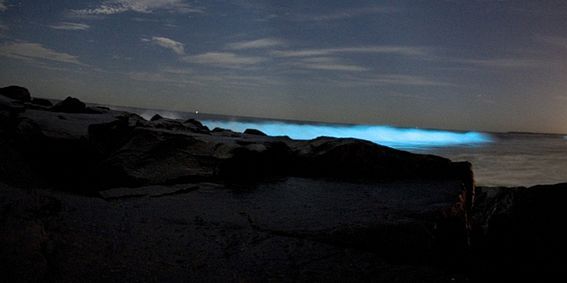
Full moons are full with magic, and beings of an arcane nature may become inebriated if they drink the shiny foam crowing the waves at such nights. The goddess herself feasts on magic until reaching oceanic proportions, covering herself in a dark manta which some say is Mobula, starry and shadowy, the embodiment of the deep midnight.


    Just as sailors have a thousand tales about the sea, Nyxcilla's faithful have two thousand tales about the goddess:

... The sea becomes unruly if the goddess smells spilled blood on the water, like a shark.

... She can perceive everything where the salty water reaches, even in the low tide.

... The moon is a pearl that Nyxcilla kept to herself in her night.

... Eclipses happen when she swirls around the moon's reflection upon the ocean, sinking it beneath a maelstrom of salty froths.

... Womenless ships are more likely to be wrecked by the goddess.

... Crews lost their route, unable to distinguish the horizon between a starry sea and a dark ocean, teeming with sparkling specks like a shoal of sapphires and emeralds.

... Her eyes are actually the biggest pearls in the whole world.

... That she creates waves and storms which make people and ships vanish, finding themselves in far away places, unconscious and now capable of conjuring magic.

Crown of Thorns-jonhanson by BrunoKopte
... Her terrestrial mount is a titanic starfish, and a migrating mat of crimson crabs the vanguard.


Various pearls by BrunoKopte

... Nyxcilla lays great pearls, each containing a single and random spell.

Foolspot

FunDraw-dot-com-Humpty-Dumpty-1 by BrunoKopte                                                                              FunDraw-dot-com-Humpty-Dumpty-2 by BrunoKopte

    Any map which situates Foolspot is probably useless for you to locate yourself. Some may be as precise as to sneak themselves and fool pursuers, or worse, take them to Foolspot. One can only be sure when seeing this marker:

Two hours from now, you'll be at Foolspot, where madness lives on.
The way is dark, but remain hopeful or the Shadow notices.
Population:

3.187 actors
3.189 watchers
15.329 traumas
Too many desires
12.835 loves

37.010 dreams
Watch for the Maruxo, he bites.

    A roaming city, staging visible sounds and audible colors, tense masses and festive conflagrations, happy wars and painful holidays. Whoever eyes it tries to understand, lets his curiosity own him, and adds another hooked one for the show.


Scaffolding becomes trapeze
Costumed neighborhoods
Caged taverns
Translucent castles
Cannibal princesses

Lionesses painted with signboards
Balconies become stages
Granaries made of canvas
Neighbors pretend
Plazas unto circus rings

Enlightened by wishes

Surrounded by nightmares


Festive surroundings where laws are defined by our imaginations, desires, fears and guilts. Mostly those guilts. Here one grasps his own lunacy or is grasp by her, whatever the difference may be. Where Foolspot lies, sanity boils and insanity brews, distilled into the very spirit of madness. A place where people believe in gods, but gods disbelieve people away.

Please be careful of the differences between what you wish for, idolizes, fear and hate. Otherwise you may pass through Foolspot and mistake it for any other city, for every city has things for you to wish for, idolize, fear and hate. At Foolspot the only limits are past and future. They won't come, give up.

Watch out for anyone smeared with butter, bulging houses, jellied flooring, sudden whistles from empty cages, plastered penguins and that dark thing following your movements. The gabbler cheese triggers new beliefs at each bite. And if the stairs are in the wrong diagonal, blink, you may be lucky or be guided instead. Look for the mayor's best friend, he loves rogues and will be right beside you as long as you remain sane.

There is an all-embracing library, full of mundane details and extraordinary matters. Very well organized in an alphabetical fashion by unruly illiterates. They say that here one can reach for all the existing books, many of the ones which don't exist, all once existent, books desired but unwritten, biographies of those which came here if they didn't, happy endings, unhappy endings, uncertain endings, endless endings and a few detachable ones...

Carnificius, god of death


Carnifex, God of Death by BrunoKopte
Names and epithets: The Selfslayer, Akhlys,
The Falxer, Moros, Anaplekte, Munus Ak'ludi Rex.
Alignment: LN Domains: Death e Grave


431px-Falx by BrunoKopte
Symbol: falx


450px-AdamclisiMetope37 by BrunoKopte
An old goblinoid weapon, the falx was adapted from the scythes they used when enslaved by the Amaranthine Empire. 
On its balance as sword of killing and scythe of harvesting, it's considered perfect for reaping one's enemies.


    Among the oldest of the northern gods, his worship began during the amaranthine height. The ancient amaranthines had a tradition to celebrate their ancestrals with death matches among slaves. As time passed, this became a custom to honor the soldiers fallen in battle with fights among gladiators drafted from conquered peoples. Such was the case with the hobgoblins, except for an unknown individual, which instead of giving in to the courage and iron of amaranthine veterans, overwhelmed them with ingenious and amazing barbarities. This affronted the very core of the amaranthine civilization, and so numerous warriors and beasts were sought to kill the gladiator. Archers, rhinos, megatheriums, demons and people maddened with promises of riches, blood and renown. The gladiator executed all of them, becoming feared and revered in equal measure, shaming the aristocracy and inspiring the slaves. Unbeaten for years, his apex was to slay a beast from far lands called Tartaran Boar.

    After some moments, he jugulated himself. The shock of seeing the invincible gladiator committing suicide dazed the whole arena. Soon came whispers and hearsay, of how this warrior was death incarnate, so fatal that only he could kill himself. This belief spread, catalyzing his glory into true apotheosis.


607px-Old bracelets (aka) by BrunoKopte

Oh, the sheer irony of the god of death being forced to be such, like if he continued  to be a slave, even nowadays. If you think this is bullshit, tell me: Have you ever seen any mention of Carnificius wishing to be a god when he slayed himself?
-Kerviridi, gravedigger at the Chouette fiefdom


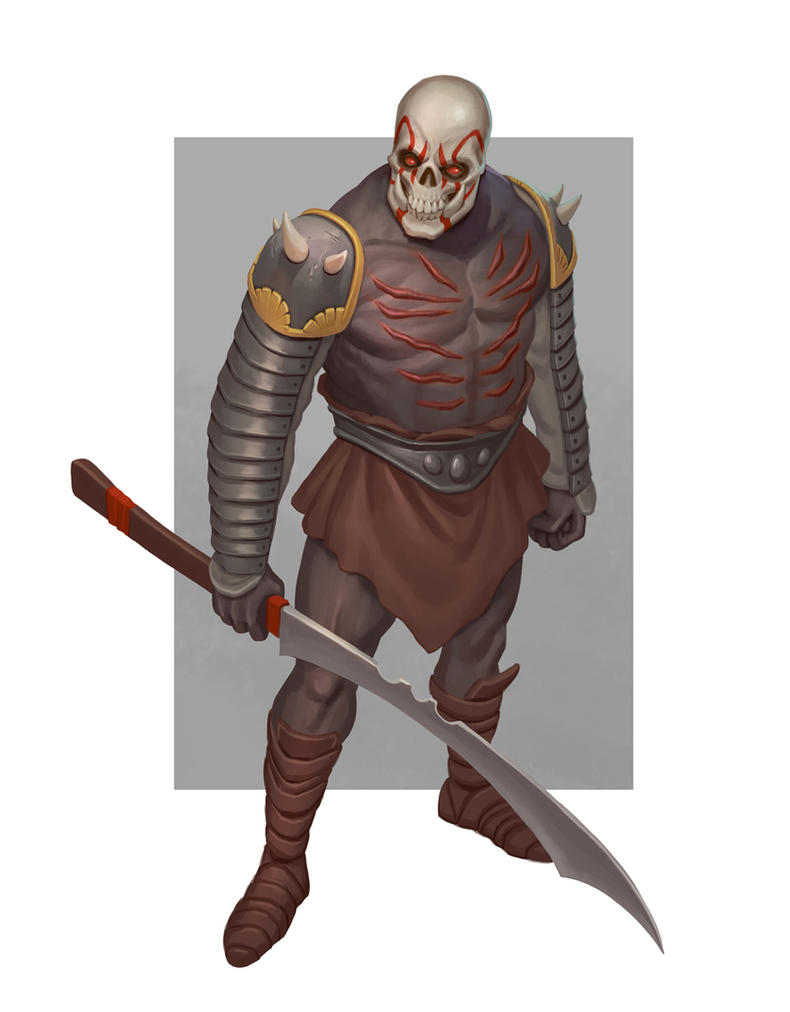
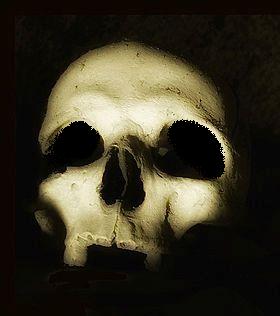
    Became Carnificius, god of death. A giant hobgoblin, of tattered trousers and a chest striped with long red scars. His face is wholly tattooed in white, perfectly defining the bone underneath, in contrast to dark and empty eye sockets which still can target precisely where to cut with his falx, itself capable of beheading a dinosaur.


600px-Skull 3, foto Augusto De Luca by BrunoKopte

    Just as the gladiator had fans and enemies, the present deity is hated and loved: to most of the northern empire, is to be feared, and his ghastly and goblinoid appearance matches the universal rejection of death. However, to the empire's slaves, many of which are goblinoid themselves, Carnifex is a watchful punisher, providing them with revenge when the empire ignores injustice. A tale which scares a few and lulls others is how the maganchos, Carnificius's secret thralls, can emerge from the darkness within water wells, using hooks to drag the unjudgeable to the arena where Carnificius will make them pay for their crimes.


7528527 by BrunoKopte
Strigil
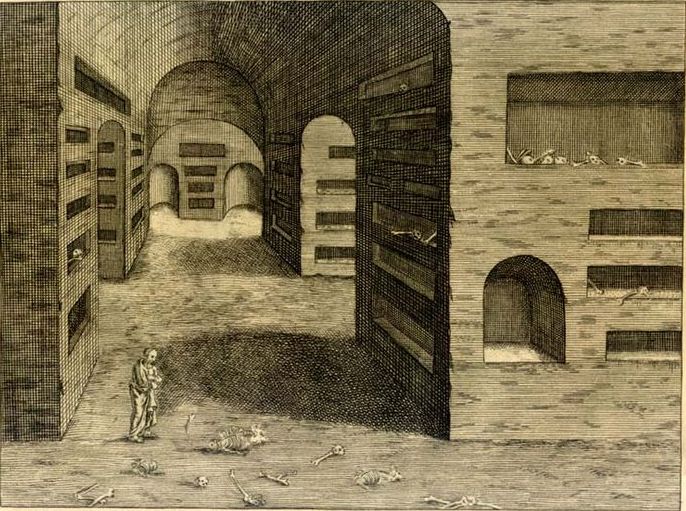
    This tale is singularly uncanny because of four facts: the loathing towards death obliges the empire to employ public slaves to maintain graveyards and public catacombs; these very slaves clean and prepare corpses for burial with small, sharp curved tools called strigils; Carnificius's cult trains the thousand of executioners employed by fiefdoms and imperial cities; and public slaves are used to inspect and repair aqueducts throughout the empire. Some combine these details into proof that there's a secret organization of assassins and vigilantes.

    Another duty of the cult is to keep "dead" places, namely, which became deserted after disaster, disease or warfare, and convert them into necropolis. Walls become headstones, basements are connected as a single vault, and this way an empty village may still shelter the lifeless. Each necropolis must have at least one priest to guard, appease and look after the dead. A necropolis must be examined every ten years, to check if the dead may let the living come back.


773px-Naplescatacombs by BrunoKopte
The newest and greatest necropolis is on the imperial far south, made from what was left of Ashbel after its sacking during the Retaliations War. The upper echelons of the cult request the use of the rare and valuable railroads, to transport the bones overcrowding necropolises at the north and house them into this vast and wasted mournful sanctuary.

Trumuskerra, deity of destruction and creation

Cloud to cloud lightning strike nov08 by BrunoKopte

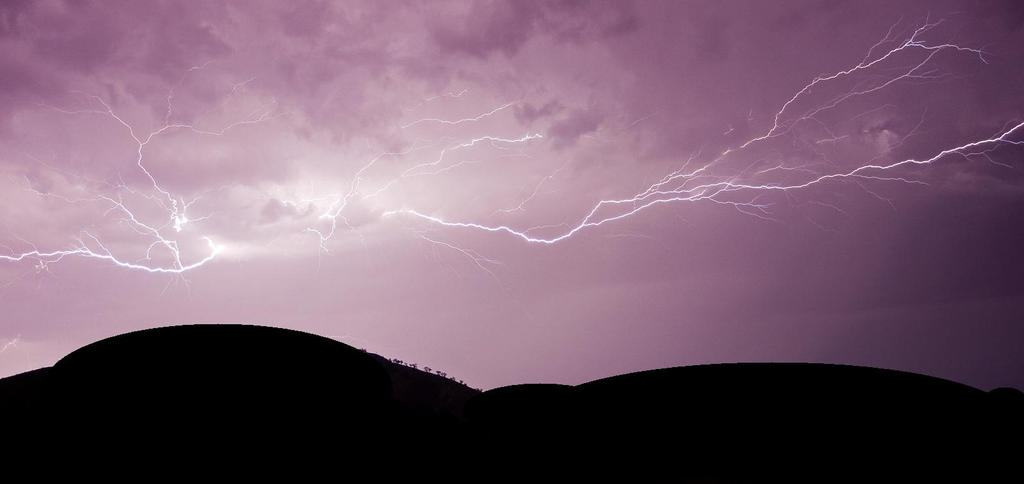
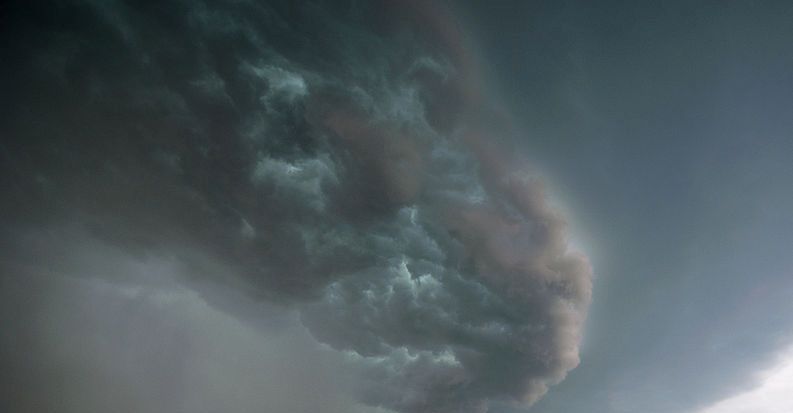
    As suits their savage mentality, the komatai worship a divine beast jointly with the umóks, Trumuskerra. Its name means "thunder-lizard", and well translates its raw physical power as a storm shepherd. It is supposedly the last of the Neades, legendary primordial entities which could tear the earth itself with their roars. Any vegetation in Trumuskerra's path is laid to waste, and soon reborn through the storms which follow the deity. The komatai value this as a lesson about the cycle of nature and their traditional nomadism. To imperial eyes, this shows a god ravaging the lands of those which devotion it finds lacking, an extortion converted into a valuable custom by the barbarian pride. There are tribes whose totem is a single aspect of its divine anatomy: the dorsal plates coiled with the lightning which lowers into its legs and the soil; hoofs generating trails of lakes which, combined with seed-filled feces, regenerate entire groves; tail capable of sharp and thunderous lashes; the countless dark stripes made from scars which express pain and age; and finally its bellow-like viscera, hollow and rich with manadipose tissues, making it lighter and capable of exhaling terrible pressures and sounds towards obstacles ahead.

    The polymath Memont Liakhov-Tyan-Shansky argues that neades' herds could generate horizontal hurricanes to propel themselves by great distances, with their tails as rudders and dorsal plates as sails. He defends that Ghara was once home to an entire titanic ecology, plants and animals of incredible dimensions and capabilities. He also theorizes that the legends about the Charybdis entity at the Fortune Sea originate from a oceanic voyage by Trumuskerras between the Umók Islets and Sarba millenia ago. Finally, he arrogantly believes that all present races descend from dwarves which left their underground burrows after this epic ecology was extinct. The scholar seeks resources for an expedition dedicated to track and observe the deity, learning more about its anatomy, migration patterns and local folklore about it.

    His detractors say he seeks to influence and manipulate its directions. Considering that Trumuskerra followed the goblinoid invasion during the Retaliations War and had to be countered by Diveus itself through precise beams of caustic light, this is worrying.

Alignment: N
Domains: Life e Death

Relict

Thunderstorm approaching (10080493376) by BrunoKopte
   
    Trumuskerra advances. From its back, three rows of peaked plates creak under the wind, gathering the lightning bolts of the cloud herd. Its flanks display fossilized scars, where winged reptiles seek weak points to pierce with their beaks. Brief blood falls nurture entire broods, and imbue the landscape with dark red. Forests are reaped by colossal pressures and detonated by electrical discharges. Carcasses on fire are squeezed into lumps of coal and specks of diamond. The hoof rises, and begins an arch under which a fortress would fit.

    Trumuskerra advances. Hills of dung fill the craters pressed by its trail. They are peppered with inhaled seeds, strengthened by the divine labyrinth equivalent to organs in mundane creatures. Sprouts compete for nourishing territory with bark, thorn and poison. A sound rises above the thunder, the swelling of lung cavities. Twenty, fifty, two hundred, all. A cavernous neck belches a humid and foul horizontal tornado, breaching a granite slope. Migrations change course to avoid the shockwave.

    Trumuskerra advances, as always did when searching for a mate. As she has been doing for millennia. Chewing a dragon with more boldness than respect towards nature, the last of the Neades still seeks. This strong denied instinct is exhaled during its pass, fertilizing plains and toughening seeds. Komatai see this as the natural force in the cycle of life and death, creation and destruction. Ignore that if they decoupled such concepts, Trumuskerra could conceive from their faith, spawning an offspring of mighty beasts, avatars only of destruction.

The Informal Gods

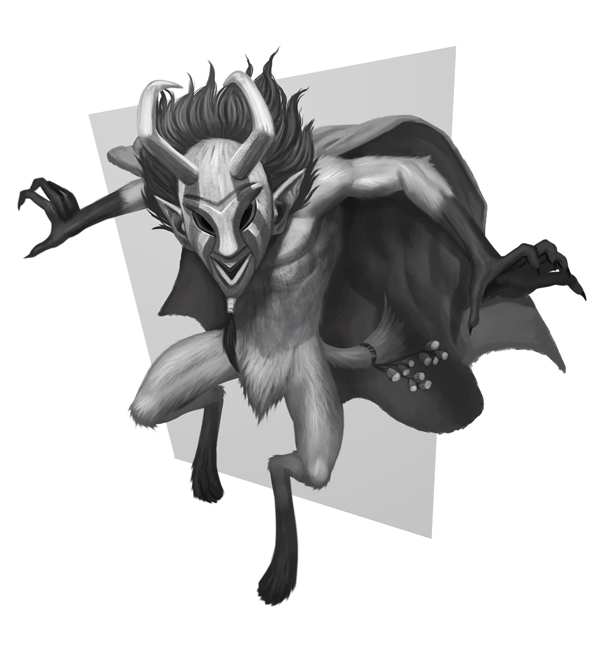
    As a certain crocodile said: hello. Don't you remember me, my dear? Of what we did together yesterday? The Entrudo, do you remember? I'm That One which was with the Maruxo, the god of marginals.

    He's only the god of what is not civic neither cultivated, of the instinct from within and what is left out there. Always looks familiar because you saw him before, but never can tell where, and that's the way he likes it. The voice always excites, despite sounding brute and rough. This is because a part of you remembers the wild things he sang, of the frenetic dances you both shared, of the sweat and other fluids you spent on Maruxo's presence.

    You were lucky, not even I know where go the people that he vanished into his cloak. Perhaps they are those anonymous which always fill the crowd without being paid attention. If that's the case, those nobodies must go mad after a while, alone and free of all. Perhaps he does that for me, to nurture me with those sacrificial snacks of sanity ruptured until becoming dark gaps of vague whispers, masked by dirt and baffling expressions which value me beneath bridges, in cries and curses at the street corners, in those grey gaps between the dark reality and the clear imagination.

    Me? I'm just your imagination, of course. If you disagree go tell what I said to the others. Tell about what I did at your larder yesterday. They'll look at you with suspicions and uncertainties, put you on the other side of the frontier they put themselves, and you'll be with me more and more. Or not. Stay quiet, tend to this doubt of what or who I am, this light apprehension nibbling your nape from the inside. You don't have to decide, I marked you already.

    We'll see each other at the next leftover day. I promise that this time you won't forget. And if you unbehave well, I'll even bless you instead of the harassing. After all, everything has a good side and a bad side. Even craziness, even I. One of those kisses from That One for you.

    If it helps, I'm almost certain that the Maruxo isn't a spirit brewed from my head, just like you. It's hard to be sure when it comes to me, you know?

...

    What is it? Want to meet the Maruxo? The Thousand-masks, Rattling Horn, Longer-Tonguer, Kukafera, the Damnatio Memoriae, the Panjoyner of the Menads? Alright. A ritual is necessary. A normal life is a journey, a road limited by routines and familiarities. But there at the bush is the Maruxo, the hermit watching you, handling the mirror to blind your eyes and take you off course. Haven't you ever asked about those noises which wake you up in the middle of the night. A baby cry, two desperate howls, three footsteps at the roof? Mothers throughout the empire talk about the time of not going outside. They can't tell why, but the maternal instinct is good at sensing threats, and the Maruxo can be one of the worse influences upon someone's life. It's not for nothing that people feel safer in groups at night. Being gregarious is anathema to the Maruxo. What is it that gazes at us during the early hours, and answers to that craving of screaming, running and fornicating? The Maruxo!

    The ritual is like this: First, do something unusual, foreign to the routine of your fellows. For some, it's enough to be the local-black-sheep, the adventurer, the drunk, the sleepless. It can be harder in greater and more diverse agglomerations, but even at the capital there are auspicious places and moments, marked not by the stars and phases of the moon, but by the number of extinguished torches and something readable in the shape of the crowd ignoring you for one instant.

    After crossing this barrier, go walk in circles. At the city, at the forest, it doesn't matter. What matters is reaching by chance those places that the maps never mark. If you do it well, there'll be less and less people, but you'll start to find the clues. They may be suddenly understandable grafitti, mutts leaning into suggestive directions. backwards trails, gargoyles blinking at you, street prophets whose verbal incoherences are deciphered through your circumstances. They will explain how to finish the journey

    That way you shall know the cult of the Maruxo. The Asides, as numerous as they are ignored. The healer with herbs on her hair, serving at the gap between two warehouses. The vagabond stalking at the corner, masking grudge and angst with words gently hollowed, a gaze of predatory anxiety. The drunk praying to his empty bottles, the meek giving orders for their own shadows, the unwanted orphan, at the corner with his broken toy. The Maruxo goes along with the loners, and blesses them with the reflux of spirits, the pain before the relief, the eroding of good manners, the damp gunpowder, the beyond-the-limit. Remember the prayer painted where no one goes:


If you forgot or lost
The Maruxo remembered and discovered
Torn clothes, quiet voices
The never loved, the rebellious sons


    Where one worships Maruxo? Nowhere. Everything big enough will have parts ignored by most. At a village, there'll be a grove which people avoid. The well covered and forgotten inside the castle's wall. At a city, neighborhoods bypassed by most. The dark of the night, filthy sewers, abandoned forts, where one worships the Maruxo there's no one. At least, no one worth remembering.


Maruxo, deus dos marginais by BrunoKopte
There's only this weird drawing.

...

   What do you want to know? Entrudo? That doesn't exist, and we like it that way. The northern civilization, so glorious and rational, so victorious and renowned, so proud of its qualities. Not even the calendar escaped. 13 months for 12 gods, 364 days dedicated to the great northern pantheon. There was one left, what to do with it? Leave like that, it's a leftover, an extra day, an exception with no importance, who wants to worry about the exception, isn't that right?

    It was the crack that me and the Maruxo needed. This gap into such a organized and rational calendar was the perfect breach where we made up for our lack of months. And how to compensate an entire month dedicated to one god, in one day. And a couple of gods? Entrudo, with the Entrudo.

    For a day, we sacrifice the civilization and sanity of the whole empire. We invoke fountains of drinks, talents to dance, phallugots to satisfy those without pair. After, inebriated with adoration and other things, we make everybody forget what happened.

    The next day, one sees the true extension of the powerful ignorance invoked by Maruxo. No one finds odd that a relative is missing, some causeless disasters, another body floating at the river. No one, except for those marked by me. The newest beggar at the main street, whose fogged memories are further blurred by me, by the power of alcohol, by the pain following the remembrance, by the effort with which the passerby ignore his words.

...

That One?
That One who?
Are you crazy?

Diveus, sun-god and patron of the Northern Empire


800px-Sunrise (big) by BrunoKopte


Through the Great Eye

Righteous and effulgent

Many are cast

Into an empire

-Prophetic epitaph on Iskander's crypt, the prime emperor.
Adopted as the first Imperative of his cult.
 Names and Epithets: Magnuminus, the Unbeaten, Scopo Divinam Juramenta,
Pater Patriae, Tallarxo Magnus, Terminus, the Sublimator.
 Alignment: LN Domains: Light and Protection


70px-Antorcha.svg by BrunoKopte
Symbol: Flaming Scepter.


    Before speaking about the god, one must address the mortal he was. Iskander was the first emperor, elected to expand an agglomerate of people into a grand empire. In five years, he conquered a thousand cities, defeated three hundred tribes and enslaved two million. In the meanwhile, he founded fifty baronies, to defend the twenty new duchies arising from his conquests. And even though the empire kept a constant expansion, it could never repeat Iskander's rate.
    Through him, the dream of the Union of Imperial Duchies was materialized, a beacon erected on the darkness of the previous centuries. His sudden death was a shock and a disgrace, compensated with the construction of a magnificent mausoleum, surmounted with a sculpture crowned with flaming laurels. The peregrinations soon began praying to the personification of loyalty, justice, ambition, power and glory entombed there. To thank for the empire's creation, Iskander was deified, bringing forth Diveus.
   

Aureus Didius Iulianus (obverse) by BrunoKopte
If thou wishes to abandon my sovereignty, just hide from the sun for the rest of your life.
-Diveus adressing the leader of an uprising.


After incorporating his essence into the statue, he challenged his worshippers towards shaping it into a worthy divine body. Around him, a titanic concavity houses prisms ordered in concentric rings, reflecting the sunlight unto Diveus. It is necessary to walk by the Aorta Way to avoid the extreme heat. The mausoleum, despite already being splendid with its many bright gemstones adorning the white marble, is only the pedestal of the sun-god's body. Those which dare to raise their eyes shall see four gryphons of lapis lazuli, purple marble, olivine basalt and diabase holding up a shield of aluminum gilded with gold and silver, from which Diveus erects himself in his whole resplendent glory: skin of chrome steel plated over the original stone; bones of adamant sustaining it all; a hard visage with an aquiline nose, full beard and hair composed of shining curls in resemblance of a lion.


 Zeus-Serapis Heraklion by BrunoKopte 
The mausoleum was the womb
Iskander the seed
Nourished by our faith
Diveus became

 -Delfaiolita Sybilaris, medusa prophetess of Tallarx.

Each majestic lamellae represents a duchy, each maille ring a barony. Together, form the Armour of Diveus. These plates reflect not light, but the conditions of the region which forged them. For example, the Lamellae of Sycamore cracked during the siege at the Revanche War, and the Ring of the Viedra Barony rusted when it was infested by nefilims. On his back, a stiff, triangular cloak frames the painting of Iskander's greatest feats. Diveus' interior is not any less wonderful, containing a spectacular metabolism. The light he receives is absorbed into geodesic ganglia, and then liquefied into a burning fluid. This divine lymph runs through tungsten solenoid channels until the capillary endings, which focus and mold this divine blood in a laurel crown bright and hot like molten gold.
175px-Gurlitt Constantine column with statue by BrunoKopte                          118px-Gurlitt Arcadius Column by BrunoKopte

A blessing given to certain towns are the huge columns of Diveus,
illuminating public squares, markets and roads at night.
The greatest example is Tallarx, "the city where the sun never sets".


    On front of the mausoleum, there's an obelisk shaped as a sword stuck on the ground. One may climb the steps carved in the blade until staying directly beneath the fist of Diveus. Whoever achieves the right and humbleness to reach it must promote his wishes with grace, respect and tact. After wards, must wait. If the hand remains closed, the sun-god ignores one's desires and questions, and the supplicant must leave before the pair of Vorkai which adorn Diveus' spaulders be set loose. If the deity decides, he will announce it by opening his hand. The downward thumb means that he decided to punish one's audacity, usually with a beam of caustic light. The upward thumb launches a bright beam into the heavens, signaling the world that he agreed with one's will. Finally, generous Diveus may use his forefinger as a beacon, showing the direction one must go to fulfill his wish. This hand is the only part of the statue ever seen moving. If Diveus decides to act beyond Tallarx, he reflects his power through Aetus Divus, or directly controls one of the Vorkai.

Some loathe the sun-god, blind to his majesty. Foolishness. Believing
in Diveus is to have the dawn backing you, blinding the enemy.
  
-Yauna, champion of Diveus.

800px-Sun pillar5 - NOAA by BrunoKopte
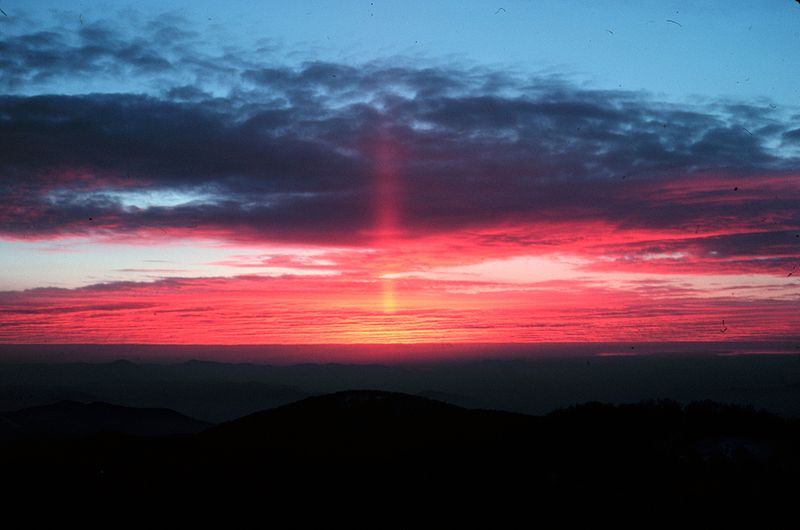
The beam of my light is the empire's backbone. -Second Imperative.

With such qualities, Diveus represents the infallible divine justice, safety, loyalty and power, despite including severity and arrogance. Many of the pilgrims which visit Tallarx seek a sign of the divine justice, be it a sun mark upon the forehead, being blessed with an artifact, or the right to command a Vorkai. This means that Diveus decided that a vengeance is just and the victim gained the rights and means to execute it. The faithful show their devotion with mirrored objects. A knight may polish his armor until it shines, or inlay gemstones, golden fluting, or if humble enough, colored glass. Priests of Diveus usually use gorgets and cheek pieces which resemble their deity's beard.

The first time I withstood the full glory of Diveus? I was being chased by a cyclopic creature, when a great flash dazed me. Next came the sound of a thunder being unsheathed, a scalding wind, soot covering my face. My vision returned after a few hours, only to see a black scar upon the ground. It was all that was left of the beast attacking me. Since then, I believe that this statue is just the shell of his divine core, a catalyst for his essence. Diveus is light and order, leadership and conquest. We believed to be raising a monument for our first and greatest emperor, when we actually fulfilled the prophecy of His ascension. I love Him, I fear Him, I'll do anything for Him.
-Yauna, barbarian king converted in a loyal servant and a champion of Diveus.

The worthy few shall have the honor of being admitted into the Aureocular Atrium, know the words which open the Golden Gate of Nártex and enter the mausoleum-pedestal. Here they shall find the Ventricular Nave, flanked by aisles filled with sleeping Vorkai. At the main chamber, one may offer his tribute to the Tombstone Altar, the union of countless relics around Iskander's sarcophagus. But, as much as rocks, jewels, helmets, amphora and swords may appear to be fused, the will of Diveus suffices to produce an artifact for deserving vassals, such as: the Pyroclastic Siphon, fed by the sun-god's sweat; the chromatic bullets, which burst from the barrel like strident needles of sheer heat; the Refulging Scepter, topped by a corona of revolving sparks which rend and burn.  

I order the Sun.
I am the Sun.
-Third Imperative.