Mostrando postagens com marcador places. Mostrar todas as postagens

sábado, 27 de abril de 2019

Dhalikastra

I saw a forest made of trees whose roots were made of hundred of fingers, each one with a thousand knuckles; sprouting eye-fruits and ear-flowers; trunk with a bony bark and teeth instead of thorns; great locks of hair in place of leaves.
 -Litua Kortos, lilim of the Dhalikastra's garrison.

     This fortress' role has been to lure nefilims for the last four hundred years, drawing the evils of the Unquiet Lands. If something conquers it one day, the garrison has the duty of warning the world of this. Dhalikastra is shaped as a titanic hexagonal prism, red and bright amidst a land of an opaque, dead grey. The radiance pours out of the goddess Dhalila herself. It sustains, protects and heals the defenders, at the same time attracting nefilims like ants seeking sugar. And when they come, the guardians gather in walled balconies and shoot from arrowslits, protected by heavy adamantine armors. The latter are reinforced with leather and cloth to portect their users from the toxic elements and the ocasional vacuum of the Unquiet Lands. Every helmet must have a glass-sap visor and miasma filters.

    The current castellan is Volya "Smeyas". A blond shardokan, with dark circles under his eyes and grey spots in the arms, wielding a flintlock grenade launcher. Like all which stay here, he adopted a new name for a new life, leaving his old self outside the Unquiet Lands and the terror that they create:
My babuskha, Valeria, told me how the man she loved was attacked from within his own guts, and how she had to kill what was left. She told me of a voyage which lasted a year more than it should, being awakened in the midnight by a feeling of pain and finding saliva and bite marks where it hurt. May Corallin forgive my baba for burning down a forest to escape the Thing That Laughs. When baba died, I sacrificed ten sheep to Corallin so her soul would reincarnate into a better life. Then I came here. Volya means "freedom". I spent my entire life afraid of the stories about the terrors and carnages she saw. I was tired of being afraid, of being a victim of these bastard things with larval teeth. Now, even amidst this hell, I'm happy. You can't imagine how good it feels to be free of the fear which was more intimate to me than my own parents. My nickname here is Smeyas, which means "the one which laughs", because I can laugh in the worst situations. Half of it is due to despair, the other half for the happiness in finally reacting upon my fears, all of it for the chance of exploding a nefilim.

     Like Volyas, most of the defenders had their life marked by nefilims in one way or another. Many came from exile colonies for those which suffer from nefilim leprosy, administered by the Lazarus Order.
Anyone may be a volunteer, no matter the race, beliefs, crimes or status. As much honor as can be had among men and gods, amidst enemies on the battlefield, there can be no honor nor peace among mortals and nefilims. The lilims themselves agree with this. We're all equal when facing nefilims, just food and fun for them. They will regret teaching us to be equals.
     Here also lies an observatory meant to identify nefilim falling nests and the place of their crash. Most of the nests come from the Gharian Planetary Ring, therefore having rich adamant veins. Dhalikastran expeditions depart to eliminate the infestations and claim mining rights over these asteroids. Part of the extracted adamant goes to Dhalikastra. The rest is sold to sustain the exile colonies and the cult of Dhalila.

quarta-feira, 26 de setembro de 2018

Culver Barony

https://upload.wikimedia.org/wikipedia/commons/e/e7/Domenico-Fetti_Archimedes_1620.jpg
I can estimate if I'll be able the imperial weapon quotas by the noise coming from the wall every day, but I have to use deaf guards because a enraged bull wouldn't be heard through the hammering of my loyal dwarf craftsmen.
-Baron Culver. Every day, his barony swallows several hundred ingots of iron and bronze to produce lamellae, helmets, blades, cannons etc, besides the exotic weaponry that the baron can dream of.

The baron Caleb Culver is an eccentric and genius inventor serving the emperor. He's responsible by the design of the Palatine Walls, arming the Palatine Bears, keeping an arsenal for the capital, as well as several innovations, tools and weapons. The barony occupies an area west of the capital Noster Amaranthi, providing an extra layer to the considerable urban defenses. Culver also commands several forts and towers in the rivers which reach hte Great Lake, covering strategic points. 

The several burn scars in the baron's body attest to his inventivity and taste for gunpowder. Sanctioned company's adventurers are frequently charged with testing machines, tools and weapons developed by Culver: some fail, other don't. Sanctioned companies also have the right to buy exotic weaponry from here, incorporating materials and parts from Kosinbia, Groria or even Scarnost.

http://www.marlymachine.org/mengbot1.JPG


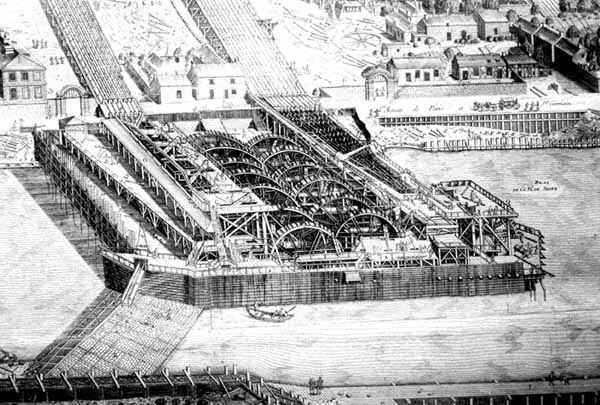
The hydromechanical power plant is Culver's pride: the second largest and most complex machine ever built in the Northern Empire (only behind Antikythera), providing energy through networks of wooden rods to two hundred and fifty pumps, workshops, forges, sawmills and hydraulic hammers. Fourteen water wheels which not only provide power, but also feed an aqueduct of Noster Amaranthi. If necessary, the plant can pump a million gallons of water in twenty four hours, making a deafening noise in the process. Sixty workers and an equal number of soldiers ensure its maintenance and security. The baron's castle is actually such a complex and productive factory that it also became a temple of the god of work, Ourgos. Many priests and clerics are in Culver's payroll, producing blessed craftwork, from nails to forges whose temperature is ideal and never changes.

https://upload.wikimedia.org/wikipedia/commons/b/b1/Vintage_image_of_steam_train.jpgThe barony also houses a scarnostian enclave, where engineers keep the starter terminal of the ironhorses which go through the imperial railway: steam locomotives imported from Scarnost. A expensive and unique technology. The enclave has workshops to fabricate spare parts, geisthane guards in mechnical armor and even pneumatic cannons to portect Technogestalt's secret technologies. Only imperial messengers, northern soldiers, important clerks and sanctioned companies are allowed to embark one of the trains. The enclave's leader is also the scarnostian ambassador.
Culver's greatest frustration is being unable to create a steam engine capable of moving the imperial trains. In the process, he realized the limits of manual craftsmanship, even if done by dwarfs, and believes that he would need scarnostian tools such as drills and lathes to reach his objective. The problem is that, not only such machines would have to be smuggled from Scarnost, they would also create a serious diplomatic incident with Technogestalt and the analogical computer which leads it, Tecnogeist.

Imperial Palace

https://upload.wikimedia.org/wikipedia/commons/7/74/The_Phillip_Medhurst_Picture_Torah_73._Tower_of_Babel._Genesis_cap_11_vv_1%2C_9._Kirchers.jpg
Image taken from here.

The Imperial Palace rises up the heavens as if to challenge them. At dawn and dusk, its shadow extends far beyond the capital's walls. A monumental tower a hundred and sixty meters tall and entirely covered in white marble, fifteen years and tens of thousands of workers were necessary to build it. Nothing was imported, all the materials used came from the empire.The Imperial Palace and its physical integrity are a symbol of the power, resources and longevity of the Union of Imperial Duchies, therefore, not a single crack was admitted on its construction. For defense, every floor has between four and eight cannons. Bartizans with rifled swivel guns in the uneven floors are used against aerial threats. The magical defenses include counter-scrying extended to the whole palace, except in a single floor. Besides, there are two seers dedicated to foresee threats which specifically target the tower. The bricks used on its construction were manufactured and individually blessed by priests of Ourgos so that they were highly resistant, also blocking the entrance of spirits and intangible creatures. War wizards used many alchemical and magical effects to test the defenses on each floor. The public archives register that in a certain moment, a meteor was invoked to hit the palace. Upon colliding, it broke in pieces, but the walls remained. Adventurers were hired to infiltrate the tower, but none went as far as the 17º floor.

The palace was built on top of a hill covered with twelve levels of octagonal terraces. The uppermost terrace houses the headquarters of the Guardians of the Boreal Crown Order, the emperor's personal guard. Their jurisdiction is the whole palace and the hill, up to the marks in the octagonal corners: the arcades of Cippis, the Fair. Only they may carry weapons and ride animals in this area. The elevated podiums spread throughout the terraces may be used by any citizen for speeches, lessons, meetings, picnics and other social activities.

The floors are as follows:

The underground has catacombs and exhausted mines older than the empire, from the time that the city was a city-state among many. Nowadays, it has dungeons for important prisoners, such as the leaders of the Terra Preta Duchy Rebellion, tombs of old emperors and senators. It also has a well and exclusive cisterns. The headquarters of the Sicarcani is here, from where the Spymaster Clovis commands them. 

1° floor: hall of public announcements and ceremonies. The northern wall has a relief composed by a mosaic combining colorful porcelain, several granites, shells and amethysts, forming the empire's map. The lineage of the mistress Aglade Tiennelle, creator of the mosaic, is in charge of keeping the map up to date. This is the only area open to the public and, when the emperor goes to his private chambers, the Boreal Crown is shown in a dome of sapglass. However, it is said that it is only a copy. The ground floor is surrounded by thirteen adamantine pilasters housing altars, each one dedicated to a specific pantheon's god and shining in the deity's respective month. Between the pilasters, flying buttresses sustain the bells which ring the end of a month and the beginning of another.

2º to 15º: the senate's hall and the senator's apartments. High panes of glass ensures the hall is illuminated by Diveus' light. Despite being a place where even dukes show a certain humility, the senators are surprinsigly open to talk with the rabble, showing looks which calculate the strengths and weaknesses of every individual. The lives of millions are decided in discussions that might show immaculate rhetoric as well as gross profanities.

16º: arsenal. Here lies an excellent inventory of weapons and armor of every type, from slings to cannonballs, from daggers to bardiches, from gambesons to full plates; It is said that the equipment includes even mechanical arms and armor from Scarnost.

17º: The public archives don't say what is here. Although one may count all the floors from the outside, the stairs and elevators (moved by windmills at the top of the palace) go from the 16º straight to the 18º. Whoever passes through here, feels an unpleasant angst which no one wishes to feel again.

18º: here lie the magic mirrors with which the emperor and the senators keep instant communication with the duchies. About two hundred mirrors, each two meters tall and one meter wide, show faraway landscapes, almost like windows or portals. Through them, bureaucrats and nobles separated by thousands of kilometers exchange information and keep the empire united.

19º e 20º: imperial war treasury. Whoever enters here faces four golems in perpetual guard. Behind them, lies an iron gate which asks for the password to whoever approaches, punishing invaders with deafening screeches and flames. The treasury consists of war spoils, like magical panoplies, and is used to finance military campaigns. When necessary, clerks of unmatched loyalty remove some items, auctioning them in the first floor to nobles and sanctioned companies.

21º: the whole floor is a great circular hall for formal meetings and feasts. A kitchen at the center uses ingredients from the whole empire and beyond to delight the noses and tastes of the guests, serving wonders such as megatherium ribs tempered with fey pepper and arrow-kiss tongues with mint. They also always prepare the emperor's favorite dish, potato with fried onions.

22º ao 26º:administrative and bureaucratic areas, as well as the most secret imperial registers: censuses, prophecies, banished biographies and people whose names were erased from imperial history. The smell of old paper permeates the floors. Due to the amount of files, any fire would be catastrophic. To avoid this, these floors used giant pirilampos as a light source.

27º: the ministerial offices; Primary Ministry, Defense, External Affairs, Internal Affairs, Agriculture, Commerce and Knowledge. These men and women act as great inspectors, checking the empire's conditions, preparing precise reports to the senate and emperor and then ratifying their decisions. 

28º: hall of the imperial throne. Where the audiences with the emperor happen. The throne is made of iron with silver inlays. The walls have alcoves housing altars with the effigies of past emperors. These are made by every emperor or empress upon assuming the crown and removed from the latter after they fulfill the cycle of occupying the many sockets on it until they new effigies are put. This way, the souls of past emperors can see the current affairs and even opine when invoked through the crown effigies. Demonstrating its magnanimity, the crown allows that any imperial citizen watch the audiences, if he registers his presence in advance. In practice, it is very hard to acquire a place.

29º: private chambers of the emperor, Basileus Quatre Palatini and his family: the wife, Diva Palatini; the son, Vasilios Palatini; the daughter in law, Beatrice Divereux Palatini; and the emperor's grandsons.

30º to 35º: the Order of Hippogryph Riders' headquarters. Includes platforms from which they take flight. From here they carry military messages straight to the baronies. From the 35º floor, it is possible to watch over forty kilometers away, see the villages and cultivated fields which sustain Noster Amaranthi, as well as the regular explosions in the Culver Barony.

Ashbel Necropolis

"We bones that here are, for yours await." - The new municipal motto

     The Feird Region is still recovering from the devastation brought by the Retaliations War. The goblinoid hordes were mostly incapable of taking big cities, but the wasting of the fields brought hunger in the following years. The whole region still depends of foodstuffs coming from Sycamore and Ametis.
     The Ashbel metropolis, in the empire's south, was thoroughly sacked and declared a "dead city" by the senate. It became the greatest necropolis ever seen in Sarba, quickly filled up with the dead of war. The Carnificius' cult convinced the senate into allowing them to use the railway to transport bones from crowded necropolises throughout the empire to Ashbel. The Duvant barony was created to stop thieves and necromancers from stealing the dead and belongings left by the living. The duvantian guardians are helped by the cult of Carnificius against necromantic threats, patrol the labyrinth of urban ruins, escort peregrines and wonder if Arcantos, Ghara's first lich, might be interested in such a concentration of raw materials. Maganchos secretly help, but they also use the ruins for their own purposes. The Athanatoi Order also helps, as long as it is allowed to recruit undead here.

https://upload.wikimedia.org/wikipedia/commons/thumb/d/dc/Old_Christmas_%281916%29_%2814780836824%29.jpg/373px-Old_Christmas_%281916%29_%2814780836824%29.jpg
It is notable that the undead which appear here aren't aggressive, some are even friendly. Carnificius' cult says this reflects the good nature of old Ashbel.
      The necropolis and its surroundings are managed by the Carnificius' cult. Besides mundane problems such as transporting and housing bones in ways that please the dead souls, the region suffers with hauntings at a chronic level:

  1. Many ghosts from when the city was sacked still manifest themselves.
  2. Fel's pockets must be purified before they burst.
  3. Two arachiinferi appear for every one that is banished to hell.
  4. Corpse diggers try to smuggle bones and steal sacrifices to the dead.
     Many of the public slaves brought here to reform the ruins into mortuary shelters were freed only to become part of the death god's cult. Some still resent what they see as "escaping the living to be enslaved by the dead", in the words of Vokk, hanged by trying to reanimate skeletons in the Guilty Avenue, ossuary number seventy. Flesh golem's crews are being used as workers and sources of perpetual motion. They create mausoleums, towers and artistic mosaics, all made out of piled bones and recycled rubble. The former city and its surroundings are almost a necrocracy inside the Northern Empire, managed with considerable autonomy by the cult of the god of the dead.

      The aqueducts were restored to provide a moat around the necropolis, accessible only a properly blessed drawbridge. What remains of the walls are inscribed with explanations and requests in Ispariz, the extinct language which the cult of Carnificius uses to send messages to the dead. The underground tunnel network connecting cellars, sewers and cisterns is labyrinthine. All these measures are to confuse and imprison the local spirits, including the naturally occurring will-o'-the-wisps.

https://upload.wikimedia.org/wikipedia/commons/thumb/6/67/Asmath.jpg/233px-Asmath.jpg
Dukai, the Vile. Due to unpronounceable crimes, he was condemned to death, death, death and prison. This means he was killed, revived, killed, revived, killed and his soul was imprisoned so that it may never reincarnate. The chest which hosts it is kept in a tower here.

segunda-feira, 27 de agosto de 2018

Regions of the Northern Empire


     Ametis is made up of populated plains: in a day's travel, one can pass a dozen villages, fields stretching to the horizon, channels for irrigation and the passage of barges pulled by donkeys. The forests have plenty of useful woods and fruits, and at the thick groves a peasant can hunt boars and jaguars, although hurting harpy eagles is a crime and heresy for the worshippers of Diveus. The climate is temperate and pleasant.

     Cities keep walls just to have gates where they can control the traffic and demand a toll. Neighborhoods proliferate outside the walls, fearless of being attacked. Adventurers are shunned, a sign that something is wrong in what should be peaceful lands, that disorder is to come. But there are still dangers: being caught in aristocratic intrigue; arenas house thousands of people and a dozen fights daily; bandits and monsters can be found in the highlands like the Mandible Ridges, occupying pre-imperial castles; pirates hunt the rich sea trade at the Nyxcilla Gulf.

      It is the richest region, where even modest families can afford one or two slaves. Ametians also are proud of being the core of the empire, having so many important places.
  • Population: 41 millions.
  • Exports: grains (amaranth, wheat, and barley), ametysts, ships, beer, gunpowder, wine, cannons, silver, crafts, salt and hipogryphs. 
  • Imports: lumber, slaves, sapglass, iron, mercury, cattle and alchemical fertilizers. The nobility buys many products such as sugar and frankincense. Products from all over the world may be found in Noster and Viellvier.
  1. Divine Arsenal, sacred domain of Camulus
  2. Noster Amaranthi, capital of the empire
      • Asprotelmo Scriptorium 
      • Culver barony 
      • Imperial University 
      • Palatine Walls
      • Prison Fleet
      • Sacral Theater
      • Stone Slums
      • Theater of Strife
      • Undercity
  3. Omphalos Pinnacle, sacred domain of Ourgos 
  4. Reévy duchy
  5. Tallarx, sacred domain of Diveus
  6. Tartar Cauldron, sacred domain of Carnifícius
  7. Tyrintha Petropolis, capital of the Tyr duchy 
  8. Viellvier, greatest imperial harbour
  9. Viridis Orcum,the forbidden woods
  10. Voycrater, the gladiator city


    Caledon is proud of having the "true" northern dialect, including archaic expressions so unknown that citizens of other regions suspect that caledonians make them up just to have a reason to gloat. The smaller population and lack of highlights in comparison with other regions makes them specially willing to adopt novelties coming from Scarnost, believing in the power of the technogestaltic technologies. This creates tension and even incidents with the radical druids of Ka'aari, making both sides more extreme. It's relatively unpopulated in comparison with Ametis and Feidr, but the immigration of dozens of thousands of grouros is changing this.

     An unique seasonal phenomenon are the pollen storms coming from Ka'aari. Although they may look like a golden sandstorm, they are made of a thick and quite nutritious powder. This supernatural pollen also is the raw material for alchemical fertilizers. The caledonian economy is based on cattle, lumber and carpentry: herds of capybaras graze near the rivers, pigs forage around the woods, auroch ranches fill the central plains, halflings with slings and clay bullets shepherd goats and sheep in the hills. The forests regrow more quickly than in other regions and include many hardwoods suitable for musical instruments, pike shafts, ships etc.

    This region has more hunters than the others. Most doesn't dare to enter Ka'aari. They take advantage of the many beasts which come out of it. Exotic furs, monsters for the arenas, stuffed trophies for nobles, delicious meats. For example, creatures like unicorns are worth their weight in silver.
  • Population: 18 millions.
  • Exports: cattle (cows, sheeps, capybaras etc), hardwood, pearls, fierce animals, alchemical fertilizers, salted fish, pollen-bread and honey.
  • Imports: grains, mercury, iron and steel.

  1. Ka'aari, sacred domain of Corallin
      • Sargassos Gulf
  2. Lecta Barony
  3. Tavira Shore
  4. Terra Preta duchy


    When someone thinks of Feidr, one thinks of elves, either feidralin or feidarash. This is due to Sycamore: the greater, richer and more populous duchy of the empire, the only where elves are most of the population. Sycamore is thirteen times bigger than the minimum necessary for a duchy: four hundred thousand square kilometers that go from the Icaunna river until the Jandijari. It is hard to distinguish "urban" and "rural" in Sycamore. Everything was cultivated by centuries or even millennia of elven culture. The biggest cities are in the treetops of gigantic figs; sapglass is the ultimate refinement of vegetable products; beautiful groves hide a meticulous agroforestry, dedicated to provide excellent bows and hafts; floricultures compete between themselves with hybrids not found in nature; farms consist of masonry walls covered with fruitful plants, mixes of labyrinth and greenhouse; plantations where bushes are sculpted into chairs. the result is am almost artificial nature, without savagery or randomness.


      Towards the west we find relatively arid prairies, filled with cattle and horses. Here lies the Falkner barony, a huge territory dedicated to supplying the empire with mounts and labor beasts. Those animals go to the rest of the empire through the iron road which passes at D'amaranta, the falknerian urban center, a city built inside of a gigantic and semi-intact amaranthine reservoir.

     Feidr is still recovering of the devastation brought by the Retaliations War and the brief incursion of Trumuskerra, which left a trail marked by the deity's aggressive biome. The komatai hordes, light and swift, were largely incapable of taking big cities, but the devastation the fields suffered brought famine in the following years. The whole region still depends on food coming from Sycamore and Ametis.

     A hundred thousand grouro immigrants received land allotments around the great stone bridge which crosses the Fiery River, a region that the senate intends to reorganize as a duchy. The title was offered to the former empress Laira Lua Norte, the only northern citizen considered trustworthy and experienced at handling the grouro culture. The most affected area, between the Fiery River and the Icaunna river, is full of land allotments free of taxes for those willing to spend their time training and ready for when the empire calls.
  • Population: 33 millions.
  • Exports: horses, mercury, fruits, dyes, donkeys, wine, sapglass, brandy, jabuthinian armour, adamant and textiles.
  • Imports: iron, steel, grouro rice, bronze and beer. Many slaves are bought or captured from the Goblinoid Lands and then resold to the rest of the empire.
  1. Antaios' Eye, sacred domain of Devinci
  2. Ardenellíe, capital of the Sycamore duchy  
  3. Ashbel Necropolis 
  4. Blood Ridge
  5. D'amaranta, urban center of the Falkner barony
      • Adamanda, city around the mining of an asteroid.
  6. Falknerian Prairies
  7. Jabuthorax, capital-citadel of the Jabuthorax barony
  8. Scavélle barony

     
     Yaros has boreal forests dominated by conifers, pines, lichens and firs. Most of the population lives in the valleys, surrounded by so many mountains that many communities become isolated during the winter. Almost all the glaciers and volcanoes in imperial territory are here. Combined with the mountains and forests, it results in the worshipping of Corallin exceeding the rest of the pantheon.

     Horses aren't popular here: one uses reindeer, dogs, mountain goats and donkeys. The hamask-shepherd is the favorite animal: a dog big and hairy as a bear, smart, with a keen nose and naturally aggressive towards trolls. Although it prefers meat, the hamask-shepherd can be fed with potatoes and onions.

     Yaro's frontiers are but lines in a map, the true borders are still to be shaped. The imperial presence is a number of settled valleys, mines, rivers and mountain passes linked by relatively safe roads. Barbarian tribes, monsters worse than trolls, the pure unknown: all the fears that made the senate colonize Kavaja before these highlands were right. These dangers make it so adventurers are welcome here. A sign of how the region is unknown is the custom of who tells an unlikelt story to add: "it happened in Yaros". That way, one can talk about the fat giant snake which attacks caravans looking for alcohol, or the one about the nice and bearded werecrocodile, and most will believe it.
  • Population: 8 millions.
  • Exports: furs, tools, various metals, hamask-shepherds, lumber, gunpowder, ice and eternal-ice.
  • Imports: donkeys, mercury, slaves and grains.
  1. Blood-of-the-Earth
  2. Ember Mountain
  3. Feltros barony
  4. Hamask Barbagia, the great mountain range which forms the entire region and beyond.
  5. Infinite Mountain
  6. Orgothorax Massif, the thorakitai plateau.
  7. Sclaveni, the greatest shardokan cryopolis
  8. Trogot, barbarian dwarf tribe
     Places outside the four regions, but still considered part of the empire:
  • Dhalikastra, the fortress in the Unquiet Lands which the goddess Dhalila established as her divine domain.
  • Pacific Island, Melucia's divine domain.
     Places without a precise location:
  • Foolspot, divine domain of That One.
  • Imperial Roads

sábado, 25 de agosto de 2018

Kosinbia


https://blogger.googleusercontent.com/img/b/R29vZ2xl/AVvXsEjPu0WWrTadw0e6ln87azmq3CkFBrSCNEEF2BZdnKOMOu-iAmuTB4nbfEZVZJPv46pjQQAbnxZ_Wj6AqjO8D0F8tQP_i-Qyd7N11ZzAol1E07XeOev26gIduemMn7lzQCgiEUigKRFiQg/s1600/kosinbia_by_brunokopte-d90zfk2.jpg

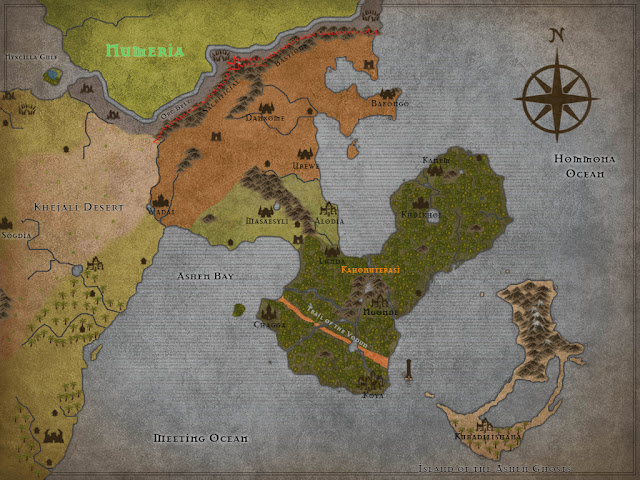
Oriental Sarba's land is divided into twelve principalities, all governed by princes vassals to the kahonuan pyromancers. Each principality contains a capital with the same name. They have differing customs, but some common points remain: hundreds of tribes submit to their respective prince; the local architecture is dominated by adobe and wood, with palaces and fortresses made of stone and terracotta; most tribes have a specialty, from glass blowing to fighting, from growing millet to building ships; it's rare to marry outside one's tribe, usually the result of treaties and alliances; tribes subdivide themselves into clans, each one with its ancestral totem venerated as a protector spirit; "Good" is what contributes for the well-being and happiness of the many, ensuring good relations between people and the community's prosperity. The "Evil" is what threatens social harmony, sociopath behavior and inhuman things; scarification is used to beautify, show affiliations and social status; every district of a capital keeps a great fire day and night, producing a column of colorful and flavored smoke. Kosinbians are proud to say that even "blind and deaf foreigners" never get lost in their cities, one only having to follow the characteristic smell of each district. Finally, Kahonua's pyromancers have the most political, legal and religious power. Every temple or monastery is charged with keeping pieces of oral lore, a valuable secret used only if necessary. Things like Kahonua's Ascension, details over the Dead Gods, techniques of heat and fire manipulation, how to commune with the spirit world. In particular, the measures of balance between sacrifices, related taboos and analysis of corresponding gains and losses are the basis of kosinbian laws. For example, inprinsonment is seen as the prisioner making a sacrifice which benefits the community, but there must be an equilibrium between the privation suffered and the gains of the many.


Danxome - The most militarized nation, due to having a frontier with the Orcoid Belt. Even a hungry peasant won't sell the spear he carries, ready to defend the principalities from orc migrations. It also has the largest and most famous cannon foundries of all Sarba, designing advancements such as composite cannons. A principality famous for its elite troops, the Ahosi amazons.


Wadai - Dominated by savannas and arid terrains. The local culture mixes Kosinbia and Khejal, going as far as worshipping gods other than Kahonua. Having one of the ends of the Ivory Route makes the wadaians natural merchants, reselling foreign goods to the other principalities. Both factors makes oher kosinbians distrustful of the wadaians' honesty and adhesion to customs. On the other hand, they don't quite follow khejali customs, for they hunt elephants, keeping the meat and selling the scrimshawed ivory.


Masaesyli - The best eland riders of all Kosinbia. Every year, thousands of nomads hunt tens of thousands of wildebeests, a time marked by festivals and dangers. It is traditional for the masaesylian princess to lead this great hunt which also serves as martial training for the riders. In this land, one's wealth is measured by the number of elands one has.


Kanem - Charged by the pyromancers of defending kosinbian waters, Bafongo's peoples build ships with powerful bow cannons to pursue pirates. This allows them to not contribute with troops to the Sacrifice Bastions, although there are always volunteers. The surplus of warriors and ships made them establish colonies and outposts as far as the south of Kavaja and even in certain points of Drakazin. The crews of kosinbian galleys are good at making the cannonballs bounce on the water, increasing the range, lethality and sometimes hitting several ships.


Urewe - Has more mines than any other principality, extracting from earth iron, quartz, coal etc. They're also expert smiths, forging ingots and items of carbon steel. It's the only principality which raises termites for eating as well for the hive's clay, which has refractory properties excellent for forges. The other local craft is glass blowing. The combination of the two results in luxury goods, with no equal in the continent: glasses and telescopes.


Chagga - Being near the Ashen Bay makes it so the region is specially rich in spirits, from beneficial intermediaries between mortals and Kahonua, to spirits which are evil fragments of the Dead Gods. This results in a great number of shamans which partially replace the pyromancers in the principality's bureaucracy and divine matters. They also can contact the ancestral totems of kosinbian clans. Even the common people can have relations with one or another spirit and some even acquire powers in the process. All this also makes the chaggians very superstitious, something reasonable in their region but almost unnecessary outside of it. This land also contains a great number of cultists which worship the Dead Gods, trying to revive them with sacrifices and profane rituals.


Koya - The mines here produce a third of the world's gold. The local princess is so rich that she avoids to buy things, not due to being stingy, but because she doesn't want to destabilize the kosinbian economy as her father did. She also borrows money at modest interest rates, financing public and private projects in all Kosinbia and beyond. She calls herself "the richest person in the world", what might well be the truth. Her fortune is such that she affords the existence of the "Knights of the Essence-Flame", a group of warriors which ride hybrids of horse and zebra, wielding spears and swords whose blades are made of fire capable of cutting steel as if it was butter.


Mgonde - It's an open secret that the current mgondian prince is a puppet of the local arcane aristocracy. Not only pyromancers, but wizards and sorcerers of all specializations exist here. One can also find arcane colleges, magical varieties of gunpowder and powerful fetishes. Many mgondian tribes specialize in the making of masks. But such items aren't only decorative: the mask of a pyromancer is a symbol of authority such as the hammer of an imperial judge. Other masks serve for one to become the host of the spirit invoked for testimony during a judgment. Tribal masks can also be equivalent to arcane wands and symbols of pacts with supernatural forces, either good or evil. Take care as to not offend the spirit which lives in your mask or fetish, or it might refuse to borrow its power.


Khoikhoi - The humid jungle prevents this principality's urbanization from growing. Besides the capital, there is a handful of towns and countless fortified villages facing the dangers of the bush. Snakes, diseases, witches, fairies, vampires... For some, "bush" is synonym of "chaos" and "hell". Few trails are safe and most move through the rivers in canoes. Many believe that one or more evil powers strive to keep this state of affairs. Some explore the bush to find out if it is true, finding ruined temples, fey enclaves and millenary necropolises in the process. The heat and humidity makes the local folk dress in little more than kilts of intertwined leaves and prefer weapons of brass or bronze instead of iron.


Alodia - The kosinbian granary. Fields of sorghum, yam, cocoa and baobab orchards go as far as the horizon in some places, irrigated by terracotta aqueducts. Perhaps the most peaceful, populous and urbanized principality. The numerous ceramic roads show a local specialty: many say that pyromantic artisans from here can create ceramic armors, and obsidian blades, which don't break easily.


Lunda - Contrasting with the nearby Khoikhoi, the lundian jungle is almost gentle. Even the fires are intentional and administered by the local druids, which understand how the biomes they guard depend of fire. Many exotic pigments are collected by the locals, making this principality the one with the most diverse and showy colors. The easiness to collect medicinal plants also favors a great number of alchemists and healers. The deep woods hide a great number of elven peoples, from an unknown ethnicity.


Bafongo - A volcanic region highly hostile to life, full of salt flats, wells of liquid sulphur, fissures spewing toxic gas and acid lakes. The pyromancers train here at the same time that benefit the local economy: at the active volcanic calderas, they learn to manipulate the lava in such a way that can extract valuable things such as copper, granite, lead, diamonds and asbestos from incandescent and viscous lakes, ingredients used by the local artisans. The people from here have barbarian customs: they live as hunter-gatherers, walk in hot coals and mark themselves with hot irons. The heat of battle and things such as flaming arrows whip them into a frenzy. Throw themselves against the enemy with throwing clubs and wooden swords inlaid with obsidian, skin glistening from sweat and so wild that they pass out from heatstroke later. Many kosinbians are ashamed from these tribes, for they represent the worst of the pre-unification Kosinbia.


Kahonuterasi - Not a principality, but the kosinbian holy land. Here reside the pyromancer leaders of the Kahonuan cult, inside a mountain which combines five volcanos with varying levels of activity, thermal lakes constrasting with lava pits.The ashen plains are highly fertile: the mountain slopes are rice terraces, producing a surplus reserved to regions suffering from famine. Many say that Kahonua herself lives in the most active volcano, the "Shira". There are many monasteries full of pyromantic monks discussing the minutiae of the kosinbian oral folklore, songs, fables and prayers considered both too valuable to be written as well as to be forgotten. There are many sages, the Miungu 'Midomo, whose divine mission is to be living libraries, keeping and transmitting knowledge said by the prophetess Amanirena herself. So they can better preserve what they know, these men and women go into voluntary comas, being awakened only when needed. These people are guarded very closely against mundane and supernatural threats.


Kubadilishana - Considered a part of Kosinbia, despite being a city in the Island of Ashen Ghosts. A paradise of pirate and corsairs coming from "here, there and thither", as the locals say. This places has everything a pirate needs, ships, weapons, maps, risky and valuable rumors, crews and even reputations (they can spread stories over the world faster than anyone else). There are dozens of languages spoken here, being fashionable to speak things others don't understand, to curse enemies in incomprehensible but offensive ways, and saying things which sound well even if they actually sound as a choking hyena.


  • Amani - Religion, war and peace in harmony
  • Sacrificial Bastions
  • Elands
  • Principal harems
  • Nyokakuba
  • Origins of Kahonua e Kosinbia
  • Wagadu, the wonderful city

sexta-feira, 24 de agosto de 2018

Foolspot

FunDraw-dot-com-Humpty-Dumpty-1 by BrunoKopte                                                                              FunDraw-dot-com-Humpty-Dumpty-2 by BrunoKopte

    Any map which situates Foolspot is probably useless for you to locate yourself. Some may be as precise as to sneak themselves and fool pursuers, or worse, take them to Foolspot. One can only be sure when seeing this marker:

Two hours from now, you'll be at Foolspot, where madness lives on.
The way is dark, but remain hopeful or the Shadow notices.
Population:

3.187 actors
3.189 watchers
15.329 traumas
Too many desires
12.835 loves

37.010 dreams
Watch for the Maruxo, he bites.

    A roaming city, staging visible sounds and audible colors, tense masses and festive conflagrations, happy wars and painful holidays. Whoever eyes it tries to understand, lets his curiosity own him, and adds another hooked one for the show.


Scaffolding becomes trapeze
Costumed neighborhoods
Caged taverns
Translucent castles
Cannibal princesses

Lionesses painted with signboards
Balconies become stages
Granaries made of canvas
Neighbors pretend
Plazas unto circus rings

Enlightened by wishes

Surrounded by nightmares


Festive surroundings where laws are defined by our imaginations, desires, fears and guilts. Mostly those guilts. Here one grasps his own lunacy or is grasp by her, whatever the difference may be. Where Foolspot lies, sanity boils and insanity brews, distilled into the very spirit of madness. A place where people believe in gods, but gods disbelieve people away.

Please be careful of the differences between what you wish for, idolizes, fear and hate. Otherwise you may pass through Foolspot and mistake it for any other city, for every city has things for you to wish for, idolize, fear and hate. At Foolspot the only limits are past and future. They won't come, give up.

Watch out for anyone smeared with butter, bulging houses, jellied flooring, sudden whistles from empty cages, plastered penguins and that dark thing following your movements. The gabbler cheese triggers new beliefs at each bite. And if the stairs are in the wrong diagonal, blink, you may be lucky or be guided instead. Look for the mayor's best friend, he loves rogues and will be right beside you as long as you remain sane.

There is an all-embracing library, full of mundane details and extraordinary matters. Very well organized in an alphabetical fashion by unruly illiterates. They say that here one can reach for all the existing books, many of the ones which don't exist, all once existent, books desired but unwritten, biographies of those which came here if they didn't, happy endings, unhappy endings, uncertain endings, endless endings and a few detachable ones...

Ka'aari


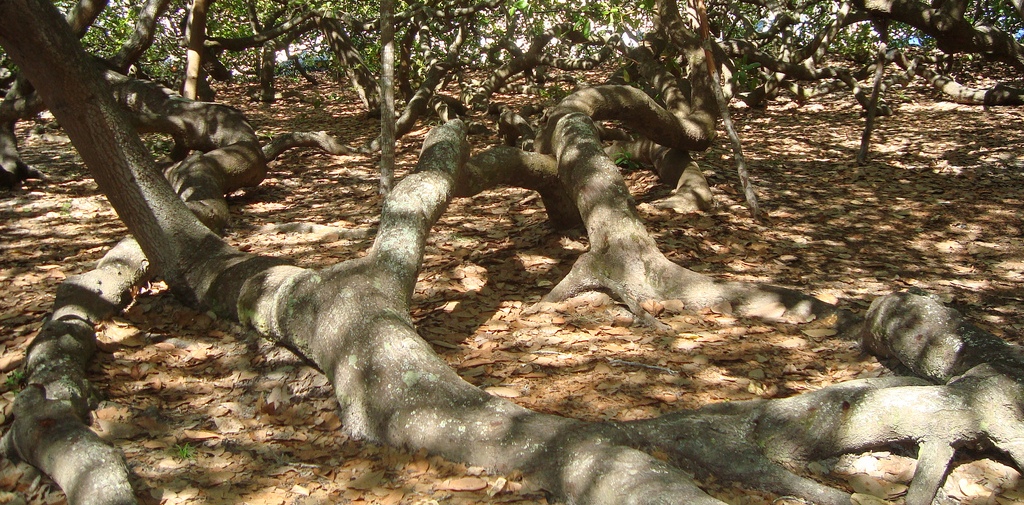
Maior Cajueiro do Mundo 2011 by BrunoKopte


    Many imperial woods and forests are thick but somewhat peaceful, places where a villager can hunt rabbits by need or pleasure. The goddess accepts it. Ka'aari, the sanctuary reserve of Corallin, is different. The soil surface is a maze of fallen logs, mounds of decayed leaves, stinging tree-creepers so wide and entangled that some trees never fall to the ground. Below all this, the soil is impenetrable due to the way the space between two roots seems to be filled by a third one. The flora's natural competition is amplified by Corallin's divine power to a point where it becomes perceptible to people.

    Look up, to your feet, behind you. Wherever your eyes gaze, you'll see olive-green and nut-brown speckled with all the colors of the world, except the sunlight hidden beyond the verdant canopy. But it's never dark. Lichens soak our eyes with orange and pink, bunches of mushrooms can be used as candlesticks which flash yellows and violets.

   The scents are of honey, garlic, rotten fish, damp wood and dry pollen, everything fresh and bitter, sweet and sickening all at once. When you think you got used to it, a new smell appears to disagree. At Ka'aari, even the smells are wild and aggressive.

    And the sounds, by Corallin Earth-Dame, the sounds. Even without rain or winds, trees creak with their own weight e canopies rustle like gossipy neighbors.

    During this spectacle, be careful as not to stumble on the nuts, huge but so wrinkled that they barely feed someone. Rest at the leave's hills that relax like a cushion filled with feathers, extend your hand to the sweet sap pouring out by the trunk side, running so thick that it polishes the rocks beneath into pebbles, use a fruit to massage your neck. Don't be hasty, it may take a day to cross a mile in Ka'aari.

    But for your own good, do not bring wrought iron here. Corallin disapproves of it. She created the rust after seeing how people abused her mineral gifts, and some local animals can make a sword useless. The Mother-Goddess gave us much, but won't fail to punish our faults. We don't mind, for we know where to find grasses so stiff and sharp that only the root can be handled.
 
-Mera Lyn’Dis (feidralin), Grán Cacique of the Conclave of the Eternal Druids, the greatest autorithy of the Corallin's cult at Ka'aari. The accusation that she lead the fleet which, recently, attacked the diplomatic vessel due to Technogestalt is being investigated.

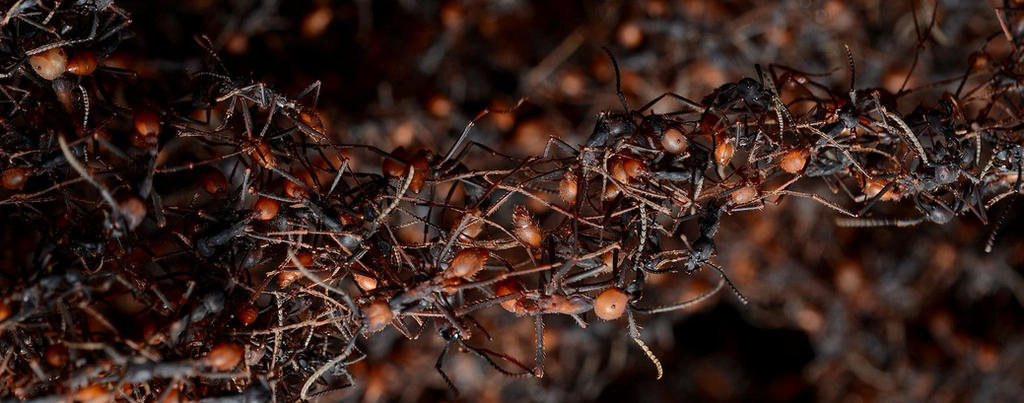
1024px-Ant bridge by BrunoKopte

    Besides the sanctuary's vegetable wonders, there are astounding animals. The sanctuary's greatest defense are the nomad hives, each ant twenty inches long plus eight-inch, double-scissored mandibles. They are Corallin's answer to any stupid attempt to deforest or civilize the wild nature she reserved to herself.
   

    Intangible nevertheless vital, anhanguás are errant spirits that may posses an animal, take away its fear and fill the void with blood lust. Long-term possessions will change the animal,
strengthen its natural weapons and skills. Dire versions of common animals and, possibly, carnivorous plants are what happens when creatures possessed by Anhanguás managed to reproduce. I don't believe these spirits mean to harm anyone, simply create a symbiosis with its host. After a aggressive period of adaptation, they become beasts as magnificent as unicorns and gryphons. Perhaps the goddess created them as a way to fortify nature against the extremes of civilization, including the northern empire.

    And prolific as only the nature can be, Corallin has more celestial servants than all the other pantheon's gods combined. The majority are the gigelorum, supernatural animals with a physical body, but so tiny they are invisible. Spread throughout the lands and waters in the empire, they affect every harvest, spring and herd. They also exist beyond the empire, except for the Restless Lands, where the nefilim ate them. Ka'aari is saturated with gigelorum. Even decomposition is faster, I have seen megatherium corpses gone after a few hours. The local tribes use caves for their temples because dead wood rottens very fast. I still remember when a ship's crew landed at the beach to capture animals, only to find an useless hulk on their return. That was more than a century ago, and their descendents now are the Pictupi tribe. They paint themselves in blue because haven't learned which resins prevent clothing from dissolving. I believe the spirits we call anhanguás are, actually, gigelorum colonies acting in concert.
-Itagi Abagna (shardokan), keeper of the prophetic beehive.

Antylia, the magic atoll

    Here, where the Sea of Nyxcilla meets the western delta of the Numerian river, mana is the plentiful, the oceanic magic interacting with fey magic. And the nature reacted to it. The atoll is a living paradise, where all the fauna and flora metabolizes mana in one form or another. The silverdust beaches and the fey woods at the surface are actually the uppermost layer of reefs which reach to the deep abyssal waters. Here, soft corals incorporate fire, air and other elements in their nematocysts, and shrimps develop immunities to such toxins. A symbiotic molusk may grant a specific spell in exchange for shelter and food. Sharks with glassy teeth can bite intangible shoals of fish. Octopuses with arcane instincts gesticulate unceasingly, decoding and then weakening the defense glyphs grown into the back of crabs. Whales, bigger in the inside than at the outside, are parasitized by remoras with vortex-mouths which drain blood and the extra internal space.

    Nyxcilla's servants fear this place, and say that if the goddess devastate it again the remains will have their reproduction and mutation quickened by magic. For even the fossilized coral isn't entirely dead, having a vague collective spirit rooted by veins of condensed magic, keeping ancient memories capable of restoring the atoll after great disturbances and unbalances. Sorcerers, wizards and sages from all over the world come here, trying to deduce spells and rituals from the sea life, or to test their skills in a environment which already killed many like them.

    The only permanent inhabitant is Berdamus, the Talassocrate. He claims to be the last survivor of a ship sunken by Nyxcilla, among other things. Whatever the truth is, his knowledge and skill in dealing with the local biology is unquestionable. He lives at a huge fossilized conch sprouting from a rock, where he formulates spells using the local species and countless ingredients extracted of such.

    I'm alive beyond what would be possible due to certain atemporal nutrients found here, but which, unfortunately, distort my perception of time. I can say that I'm sure my accrued knowledge is a fragment from all the secrets the atoll has. But, after examing certain sediments, interviewing a few nereids and talking with a very wealthy and pleasant crab: I have an hypothesis. When the Red Moon came, bringing the nefilim, it disturbed the gharian moon's orbit and, therefore, the tides. However, reports of tsunamis with drool instead of foam were irrelevant when compared to my suspicions. It is possible that a chain rection may have disturbed Antylia's biome, which reacted and adapted itself. And the resulting life form is what we worship as "Nyxcilla". The havoc that she supposedly caused here, the maelstrom which I believe to have sunken my ship, it wasn't intentional, simply the pains of the goddess's birth. And perhaps, merely a perhaps, it would be possible to stimulate as to repeat this feat, but I haven't found a way of doing that without creating a disaster of continental proportions.
-Berdamus, the Talassocrate.

Nyxcilla's birth by BrunoKopte
I remember of a titanic blue hand, whose nails were only the last scales of rows covering the fingers.